
Evaluating hyperbolic functions Use a calculator to evaluate each expression or state that the value does not exist. Report answers accurate to four decimal places to the right of the decimal point. c. csch⁻¹ 5
Verified step by step guidance
1
Recognize that the expression csch⁻¹(5) represents the inverse hyperbolic cosecant function evaluated at 5, which means we want to find the value of x such that csch(x) = 5.
Recall the definition of the hyperbolic cosecant function: \(\text{csch}(x) = \frac{1}{\sinh(x)}\), so the equation \(\text{csch}(x) = 5\) can be rewritten as \(\frac{1}{\sinh(x)} = 5\).
Solve for \(\sinh(x)\) by taking the reciprocal: \(\sinh(x) = \frac{1}{5}\).
Use the inverse hyperbolic sine function to find \(x\): \(x = \sinh^{-1}\left(\frac{1}{5}\right)\).
Use a calculator to evaluate \(\sinh^{-1}\left(\frac{1}{5}\right)\) and report the answer accurate to four decimal places.
Verified video answer for a similar problem:
This video solution was recommended by our tutors as helpful for the problem above
Video duration:
2m
Play a video:
Was this helpful?
Key Concepts
Here are the essential concepts you must grasp in order to answer the question correctly.
Inverse Hyperbolic Functions
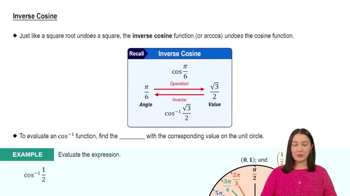
Inverse hyperbolic functions, such as csch⁻¹(x), are the inverses of hyperbolic functions and return the value whose hyperbolic function equals x. They are used to solve equations involving hyperbolic functions and often require understanding their domain and range.
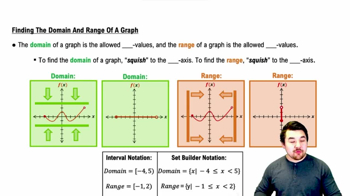
The inverse hyperbolic cosecant function, csch⁻¹(x), is defined for all real x except zero, since csch(x) = 1/sinh(x) is undefined at zero. Understanding its domain helps determine if the expression has a valid value or does not exist.
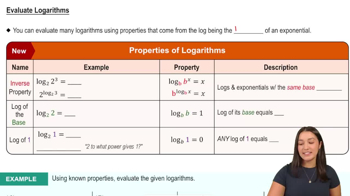
Using a calculator to evaluate inverse hyperbolic functions requires inputting the correct function and ensuring the result is rounded to the specified decimal places. Accurate rounding to four decimal places ensures precision in reporting the answer.