
Express 3ˣ, x^{π}, and x^{sin x} using the base e.
Verified step by step guidance
1
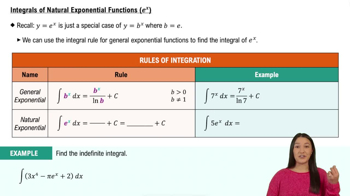
Recall that any exponential expression with base \(a\) can be rewritten using the natural exponential function \(e\) as \(a^{b} = e^{b \ln a}\). This is because \(e^{\ln a} = a\).
For the expression \(3^{x}\), apply the formula by setting \(a = 3\) and \(b = x\). This gives \(3^{x} = e^{x \ln 3}\).
For the expression \(x^{\pi}\), treat \(x\) as the base and \(\pi\) as the exponent. Using the same formula, \(x^{\pi} = e^{\pi \ln x}\).
For the expression \(x^{\sin x}\), the exponent is a function of \(x\). Apply the formula with \(a = x\) and \(b = \sin x\), resulting in \(x^{\sin x} = e^{\sin x \cdot \ln x}\).
Summarize the results: \(3^{x} = e^{x \ln 3}\), \(x^{\pi} = e^{\pi \ln x}\), and \(x^{\sin x} = e^{\sin x \ln x}\). These forms express the original functions using the base \(e\).
Verified video answer for a similar problem:
This video solution was recommended by our tutors as helpful for the problem above
Video duration:
2m
Play a video:
Was this helpful?
Key Concepts
Here are the essential concepts you must grasp in order to answer the question correctly.
Exponential Functions and the Natural Base e
Exponential functions with base e are expressed as e raised to a power. The number e (~2.718) is the natural base for logarithms and exponentials, simplifying many calculus operations. Any exponential expression a^x can be rewritten as e^(x ln a), linking arbitrary bases to base e.
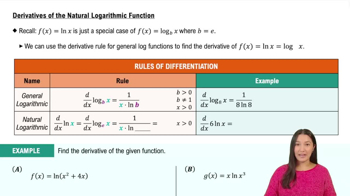
The natural logarithm ln(x) is the inverse of the exponential function e^x. It allows conversion between different exponential bases by using the identity a^x = e^(x ln a). Understanding ln is essential for rewriting expressions with bases other than e.
Handling Variable Exponents in Exponential Expressions
When the exponent itself is a function of x, such as x^{sin x}, rewriting with base e involves expressing the power as e raised to the product of the exponent function and the natural logarithm of the base. This approach generalizes to variable exponents and is key for differentiation and integration.