Determine limx→∞f(x) and limx→−∞f(x) for the following functions. Then give the horizontal asymptotes of f (if any).
Verified step by step guidance
1
First, identify the degrees of the polynomial in the numerator and the denominator. The numerator is 3x^3 - 7, which is a polynomial of degree 3, and the denominator is x^4 + 5x^2, which is a polynomial of degree 4.
To find the limit as x approaches infinity, compare the degrees of the numerator and the denominator. Since the degree of the denominator (4) is greater than the degree of the numerator (3), the limit as x approaches infinity is 0.
Similarly, to find the limit as x approaches negative infinity, use the same reasoning. The degree of the denominator is still greater than the degree of the numerator, so the limit as x approaches negative infinity is also 0.
Since both limits as x approaches positive and negative infinity are 0, the horizontal asymptote of the function f(x) is y = 0.
In summary, the horizontal asymptote of the function f(x) = \frac{3x^3 - 7}{x^4 + 5x^2} is y = 0, and both limits as x approaches positive and negative infinity are 0.
Verified video answer for a similar problem:
This video solution was recommended by our tutors as helpful for the problem above
Video duration:
3m
Play a video:
Was this helpful?
Key Concepts
Here are the essential concepts you must grasp in order to answer the question correctly.
Limits at Infinity
Limits at infinity describe the behavior of a function as the input approaches positive or negative infinity. This concept is crucial for understanding how functions behave in extreme cases, allowing us to determine horizontal asymptotes. For example, if the limit of f(x) as x approaches infinity is a constant, it indicates that the function approaches a horizontal line at that value.
Horizontal asymptotes are lines that a graph approaches as x approaches infinity or negative infinity. They provide insight into the end behavior of a function. If a function has a horizontal asymptote at y = c, it means that as x becomes very large or very small, the function's values get closer to c, indicating stability in the function's output at extreme inputs.
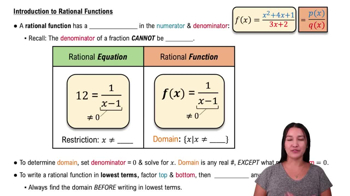
Rational functions are ratios of polynomials, expressed in the form f(x) = P(x)/Q(x), where P and Q are polynomials. The degrees of these polynomials play a significant role in determining the limits at infinity and the existence of horizontal asymptotes. For instance, if the degree of the numerator is less than the degree of the denominator, the limit as x approaches infinity is zero, indicating a horizontal asymptote at y = 0.