Higher-order derivatives Find f′(x),f′′(x), and f′′′(x). f(x) = 1/x
Verified step by step guidance
1
Step 1: Identify the function f(x) = \frac{1}{x}. This can be rewritten using exponent notation as f(x) = x^{-1}.
Step 2: Find the first derivative f'(x) by applying the power rule. The power rule states that if f(x) = x^n, then f'(x) = n \cdot x^{n-1}. For f(x) = x^{-1}, f'(x) = -1 \cdot x^{-2}.
Step 3: Simplify the expression for the first derivative. f'(x) = -x^{-2} can be rewritten as f'(x) = -\frac{1}{x^2}.
Step 4: Find the second derivative f''(x) by differentiating f'(x) = -x^{-2} again using the power rule. f''(x) = 2 \cdot x^{-3}.
Step 5: Simplify the expression for the second derivative. f''(x) = 2x^{-3} can be rewritten as f''(x) = \frac{2}{x^3}.
Verified video answer for a similar problem:
This video solution was recommended by our tutors as helpful for the problem above
Video duration:
4m
Play a video:
Was this helpful?
Key Concepts
Here are the essential concepts you must grasp in order to answer the question correctly.
First Derivative
The first derivative of a function, denoted as f'(x), represents the rate of change of the function with respect to its variable. For the function f(x) = 1/x, the first derivative can be found using the power rule or quotient rule, indicating how the function's value changes as x varies.
The second derivative, denoted as f''(x), is the derivative of the first derivative. It provides information about the curvature of the function and can indicate concavity. For f(x) = 1/x, calculating the second derivative involves differentiating f'(x) again, revealing how the rate of change itself is changing.
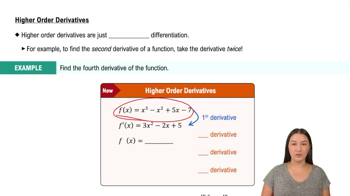
Higher-order derivatives refer to derivatives taken multiple times. The third derivative, f'''(x), is the derivative of the second derivative and can provide insights into the behavior of the function beyond just its slope and curvature. For f(x) = 1/x, finding the third derivative involves a systematic application of differentiation rules to the second derivative.