
Textbook Question
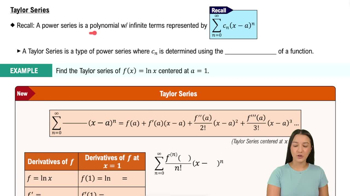
Taylor series
a. Use the definition of a Taylor series to find the first four nonzero terms of the Taylor series for the given function centered at a.
f(x) = 1/x, a = 1
59
views

 Verified step by step guidance
 08:42
08:42
 04:56
04:56 06:00
06:00Taylor series
a. Use the definition of a Taylor series to find the first four nonzero terms of the Taylor series for the given function centered at a.
f(x) = 1/x, a = 1
Taylor series and interval of convergence
a. Use the definition of a Taylor/Maclaurin series to find the first four nonzero terms of the Taylor series for the given function centered at a.
f(x) = e²ˣ, a = 0
{Use of Tech} Bessel functions Bessel functions arise in the study of wave propagation in circular geometries (for example, waves on a circular drum head). They are conveniently defined as power series. One of an infinite family of Bessel functions is
J₀(x) = ∑ₖ₌₀∞ (−1)ᵏ/(2²ᵏ(k!)²) x²ᵏ
a. Write out the first four terms of J₀.
Taylor series and interval of convergence
a. Use the definition of a Taylor/Maclaurin series to find the first four nonzero terms of the Taylor series for the given function centered at a.
f(x) = (1 + x²)⁻¹, a = 0
Explain why or why not Determine whether the following statements are true and give an explanation or counterexample.
The interval of convergence of the power series ∑ cₖ(x−3)ᵏ could be (−2,8).
Taylor series and interval of convergence
a. Use the definition of a Taylor/Maclaurin series to find the first four nonzero terms of the Taylor series for the given function centered at a.
f(x) = cosh 3x, a = 0