Ch. 5 - Integration
Briggs - Calculus: Early Transcendentals 3rd Edition
Briggs3rd EditionCalculus: Early TranscendentalsISBN: 9780136847243Not the one you use?Change textbook
Chapter 5, Problem 5.2.61

Definite integrals from graphs The figure shows the areas of regions bounded by the graph of Ζ’ and the 𝓍-axis. Evaluate the following integrals.


βˆ«β‚αΆœ Ζ’(𝓍) d𝓍

Verified step by step guidance
1
Identify the points a and c on the x-axis from the graph, which define the limits of integration for the integral \( \int_{a}^{c} f(x) \, dx \).
Observe the graph of \( f(x) \) between \( x = a \) and \( x = c \) and note the areas bounded by the curve and the x-axis. Pay attention to whether the graph is above or below the x-axis in each region, as this affects the sign of the integral.
Calculate the area of each region between the curve and the x-axis separately. If the graph is above the x-axis, the area contributes positively to the integral; if below, it contributes negatively.
Sum the signed areas of all regions between \( a \) and \( c \) to find the value of the definite integral \( \int_{a}^{c} f(x) \, dx \).
Express the final integral as the algebraic sum of these areas, which represents the net area between the curve and the x-axis over the interval \( [a, c] \).

Verified video answer for a similar problem:

This video solution was recommended by our tutors as helpful for the problem above.
Video duration:
2m
Was this helpful?

Key Concepts

Here are the essential concepts you must grasp in order to answer the question correctly.

Definite Integral as Net Area

A definite integral represents the net area between the graph of a function and the x-axis over a given interval. Areas above the x-axis contribute positively, while areas below contribute negatively, affecting the integral's value.
Recommended video:
05:43
Definition of the Definite Integral

Interpreting Graphical Areas

When evaluating integrals from graphs, it is essential to identify and measure the areas of regions bounded by the curve and the x-axis. Understanding which parts lie above or below the axis helps determine the sign and magnitude of each area.
Recommended video:
05:06
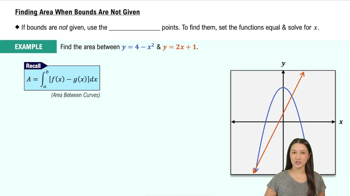
Finding Area When Bounds Are Not Given

Properties of Definite Integrals

Definite integrals are additive over adjacent intervals, meaning the integral from a to c can be split into integrals over subintervals. This property allows summing individual areas to find the total integral value.
Recommended video:
05:43
Definition of the Definite Integral
Related Practice
Textbook Question

Areas of regions Find the area of the following regions.                                                                                                                   

                                                                                                                                                                 The region bounded by the graph of Ζ’(𝓍) = x /√(𝓍² ―9) and the 𝓍-axis between and 𝓍 = 4 and π“= 5

28
views
Textbook Question

Indefinite integrals Use a change of variables or Table 5.6 to evaluate the following indefinite integrals. Check your work by differentiating.                                                                                  


 βˆ« 2𝓍(𝓍² ― 1)⁹⁹ d𝓍

86
views
Textbook Question

Indefinite integrals Use a change of variables or Table 5.6 to evaluate the following indefinite integrals. Check your work by differentiating.                                                                                  


 βˆ« [ 1/(10𝓍―3) d𝓍

57
views
Textbook Question

Multiple substitutions If necessary, use two or more substitutions to find the following integrals.                                                                                    


  βˆ«β‚€^Ο€/Β² (cos ΞΈ sin ΞΈ) / √(cosΒ² ΞΈ + 16) dΞΈ (Hint: Begin with u = cos ΞΈ .)

44
views
Textbook Question

Explain why βˆ«β‚α΅‡ Ζ’ β€²(𝓍) d𝓍 = Ζ’(b) ― Ζ’(a)

85
views
Textbook Question

Average velocity The velocity in m/s of an object moving along a line over the time interval [0,6] is v (t) = tΒ² + 3t. Find the average velocity of the object over this time interval.

160
views