49–55. Derivatives of tower functions (or g^h) Find the derivative of each function and evaluate the derivative at the given value of a. g (x) = x^ In x; a = e
Verified step by step guidance
1
Identify the function: We have g(x) = x^ln(x). This is a tower function where the base and the exponent are both functions of x.
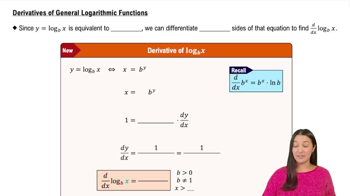
Use logarithmic differentiation: Take the natural logarithm of both sides to simplify the differentiation process. Let y = g(x), so ln(y) = ln(x^ln(x)) = ln(x) * ln(x).
Differentiate both sides with respect to x: Use implicit differentiation. The derivative of ln(y) with respect to x is (1/y) * (dy/dx). For the right side, use the product rule: d/dx [ln(x) * ln(x)] = ln(x) * (1/x) + ln(x) * (1/x).
Solve for dy/dx: Multiply both sides by y to isolate dy/dx. Since y = x^ln(x), substitute back to get dy/dx = x^ln(x) * (2ln(x)/x).
Evaluate the derivative at x = a: Substitute x = e into the expression for dy/dx. Simplify the expression to find the value of the derivative at this point.
Verified video answer for a similar problem:
This video solution was recommended by our tutors as helpful for the problem above
Video duration:
6m
Play a video:
Was this helpful?
Key Concepts
Here are the essential concepts you must grasp in order to answer the question correctly.
Derivatives
A derivative represents the rate of change of a function with respect to its variable. It is a fundamental concept in calculus that allows us to determine the slope of the tangent line to the curve of a function at any given point. The derivative can be computed using various rules, such as the power rule, product rule, and chain rule, depending on the form of the function.
Exponential functions, such as g(x) = x^ln(x), involve a constant raised to a variable exponent, while logarithmic functions are the inverses of exponential functions. Understanding the properties of these functions is crucial for differentiating them, especially when they are combined. The natural logarithm, ln(x), is particularly important in calculus due to its unique derivative properties.
The chain rule is a fundamental technique in calculus used to differentiate composite functions. It states that if a function y is composed of two functions u and v, then the derivative of y with respect to x can be found by multiplying the derivative of y with respect to u by the derivative of u with respect to x. This rule is essential when dealing with functions like g(x) = x^ln(x), where both x and ln(x) are interdependent.