Evaluate sin (5π/12).
Table of contents
- 0. Functions7h 54m
- Introduction to Functions16m
- Piecewise Functions10m
- Properties of Functions9m
- Common Functions1h 8m
- Transformations5m
- Combining Functions27m
- Exponent rules32m
- Exponential Functions28m
- Logarithmic Functions24m
- Properties of Logarithms36m
- Exponential & Logarithmic Equations35m
- Introduction to Trigonometric Functions38m
- Graphs of Trigonometric Functions44m
- Trigonometric Identities47m
- Inverse Trigonometric Functions48m
- 1. Limits and Continuity2h 2m
- 2. Intro to Derivatives1h 33m
- 3. Techniques of Differentiation3h 18m
- 4. Applications of Derivatives2h 38m
- 5. Graphical Applications of Derivatives6h 2m
- 6. Derivatives of Inverse, Exponential, & Logarithmic Functions2h 37m
- 7. Antiderivatives & Indefinite Integrals1h 26m
- 8. Definite Integrals4h 44m
- 9. Graphical Applications of Integrals2h 27m
- 10. Physics Applications of Integrals 3h 16m
- 11. Integrals of Inverse, Exponential, & Logarithmic Functions2h 34m
- 12. Techniques of Integration7h 41m
- 13. Intro to Differential Equations2h 55m
- 14. Sequences & Series5h 36m
- 15. Power Series2h 19m
- 16. Parametric Equations & Polar Coordinates7h 58m
0. Functions
Trigonometric Identities
Problem 61
Textbook Question
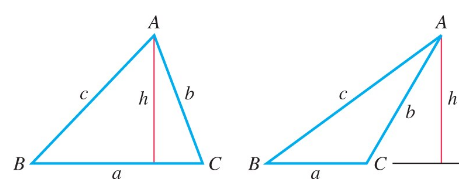
The law of sines The law of sines says that if a, b, and c are the sides opposite the angles A, B, and C in a triangle, then
(sin A) / a = (sin B) / b = (sin C) / c
Use the accompanying figures and the identity sin (π − θ) = sin θ, if required, to derive the law.

Verified step by step guidance1
Start by considering a triangle with sides a, b, and c opposite to angles A, B, and C respectively. The goal is to relate the sides and angles using the law of sines.
Recall the formula for the area of a triangle: Area = (1/2) * base * height. For triangle ABC, you can express the area using each side as the base. For example, using side a as the base, the height is b * sin(C), so the area is (1/2) * a * b * sin(C).
Similarly, express the area using side b as the base: Area = (1/2) * b * c * sin(A), and using side c as the base: Area = (1/2) * c * a * sin(B).
Since all these expressions represent the same area, set them equal to each other: (1/2) * a * b * sin(C) = (1/2) * b * c * sin(A) = (1/2) * c * a * sin(B).
Divide each part of the equation by the product of the sides involved to isolate the sine terms: (sin A) / a = (sin B) / b = (sin C) / c. This is the law of sines, which shows the relationship between the sides and angles of a triangle.
Verified video answer for a similar problem:This video solution was recommended by our tutors as helpful for the problem above
Video duration:
6mPlay a video:
Was this helpful?
Key Concepts
Here are the essential concepts you must grasp in order to answer the question correctly.
Law of Sines
The Law of Sines is a fundamental relationship in trigonometry that relates the angles and sides of a triangle. It states that the ratio of the length of a side of a triangle to the sine of its opposite angle is constant for all three sides and angles. This can be expressed mathematically as (sin A) / a = (sin B) / b = (sin C) / c, where A, B, and C are the angles, and a, b, and c are the lengths of the sides opposite those angles.
Recommended video:
Work Done On A Spring (Hooke's Law)
Trigonometric Identities
Trigonometric identities are equations that involve trigonometric functions and are true for all values of the variables involved. One important identity is sin(π - θ) = sin θ, which indicates that the sine function is symmetric about π/2. This identity can be useful in deriving relationships in triangles, particularly when working with angles that sum to π or 180 degrees.
Recommended video:
Verifying Trig Equations as Identities
Triangle Properties
Understanding the properties of triangles is essential for applying the Law of Sines. A triangle's angles always sum to 180 degrees, and the relationship between the angles and sides is crucial for solving problems. Additionally, knowing how to identify and label the sides and angles correctly is vital for applying the Law of Sines effectively in various geometric contexts.
Recommended video:
Properties of Functions
Watch next
Master Simplifying Trig Expressions with a bite sized video explanation from Patrick
Start learningRelated Videos
Related Practice
Textbook Question
98
views