
Textbook Question
13–52. Limits of sequences
Find the limit of the following sequences or determine that the sequence diverges.
{1 + cos(1⁄n)}
40
views

 Verified step by step guidance
 09:25
09:25
 07:45
07:45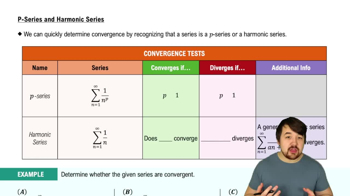 04:30
04:3013–52. Limits of sequences
Find the limit of the following sequences or determine that the sequence diverges.
{1 + cos(1⁄n)}
23–38. Divergence, Integral, and p-series Tests Use the Divergence Test, the Integral Test, or the p-series test to determine whether the following series converge.
∑ (k = 3 to ∞) 1 / (k − 2)⁴
54–69. Telescoping series
For the following telescoping series, find a formula for the nth term of the sequence of partial sums {Sₙ}. Then evaluate limₙ→∞ Sₙ to obtain the value of the series or state that the series diverges.
67. ∑ (k = 1 to ∞) 3 / (k² + 5k + 4)
6–9. Determine whether the following sequences converge or diverge, and state whether they are monotonic or whether they oscillate. Give the limit when the sequence converges.
{1.00001ⁿ}
13–52. Limits of sequences
Find the limit of the following sequences or determine that the sequence diverges.
{(1 / n)¹⁄ⁿ}
For what values of p does the series ∑ (k = 10 to ∞) 1 / kᵖ converge (initial index is 10)? For what values of p does it diverge?