
What comparison series would you use with the Limit Comparison Test to determine whether ∑ (k = 1 to ∞) (k² + k + 5) / (k³ + 3k + 1) converges?
Verified step by step guidance
1
Identify the general term of the series: \(a_k = \frac{k^2 + k + 5}{k^3 + 3k + 1}\).
To apply the Limit Comparison Test, focus on the dominant terms in the numerator and denominator for large \(k\) to understand the behavior of \(a_k\) as \(k \to \infty\).
The dominant term in the numerator is \(k^2\) and in the denominator is \(k^3\), so the term behaves like \(\frac{k^2}{k^3} = \frac{1}{k}\) for large \(k\).
Choose the comparison series \(b_k = \frac{1}{k}\), which is a \(p\)-series with \(p=1\).
Use the Limit Comparison Test by computing \(\lim_{k \to \infty} \frac{a_k}{b_k} = \lim_{k \to \infty} \frac{\frac{k^2 + k + 5}{k^3 + 3k + 1}}{\frac{1}{k}}\) to determine if the original series converges or diverges.
Verified video answer for a similar problem:
This video solution was recommended by our tutors as helpful for the problem above
Video duration:
2m
Play a video:
Was this helpful?
Key Concepts
Here are the essential concepts you must grasp in order to answer the question correctly.
Limit Comparison Test
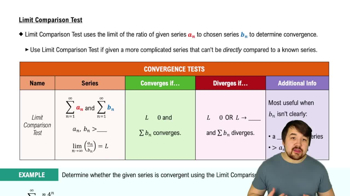
The Limit Comparison Test is used to determine the convergence or divergence of an infinite series by comparing it to a second series with known behavior. It involves taking the limit of the ratio of the terms of the two series. If the limit is a positive finite number, both series either converge or diverge together.
When analyzing series with polynomial terms, the highest degree terms dominate the behavior for large values of the index. Simplifying the terms by focusing on these dominant terms helps identify a simpler comparison series that approximates the original series' behavior at infinity.
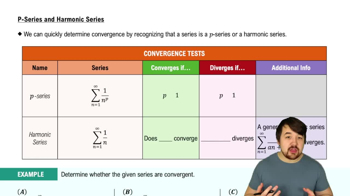
A p-series is a series of the form ∑ 1/k^p, which converges if and only if p > 1. Recognizing that the simplified dominant term resembles a p-series allows us to use known convergence properties to determine the behavior of the original series.