
41–44. Intersection points and area Find all the intersection points of the following curves. Find the area of the entire region that lies within both curves
r = 3 sin θ and r = 3 cos θ
Verified step by step guidance
1
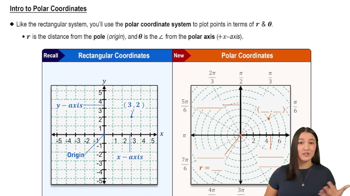
Identify the curves given in polar coordinates: \(r = 3 \sin \theta\) and \(r = 3 \cos \theta\). These represent two circles in the polar plane.
To find the intersection points, set the two equations equal to each other: \(3 \sin \theta = 3 \cos \theta\). Simplify this to \(\sin \theta = \cos \theta\).
Solve the equation \(\sin \theta = \cos \theta\) for \(\theta\). This occurs when \(\tan \theta = 1\), so \(\theta = \frac{\pi}{4}\) and also consider the periodicity of tangent to find all relevant solutions within \([0, 2\pi)\).
Find the corresponding \(r\) values at the intersection points by substituting \(\theta\) back into either \(r = 3 \sin \theta\) or \(r = 3 \cos \theta\).
To find the area of the region inside both curves, set up the integral for the area common to both. The area enclosed by a polar curve \(r(\theta)\) from \(\alpha\) to \(\beta\) is given by \(\frac{1}{2} \int_{\alpha}^{\beta} r(\theta)^2 \, d\theta\). Determine the limits of integration by analyzing where one curve lies inside the other, then compute the integral of the minimum of the two \(r^2\) values over the appropriate intervals.
Verified video answer for a similar problem:
This video solution was recommended by our tutors as helpful for the problem above
Video duration:
4m
Play a video:
0 Comments
Key Concepts
Here are the essential concepts you must grasp in order to answer the question correctly.
Polar Coordinates and Graphing
Polar coordinates represent points using a radius and an angle (r, θ), differing from Cartesian coordinates. Understanding how to plot and interpret curves like r = 3 sin θ and r = 3 cos θ is essential for visualizing their shapes and intersection points.
To find intersections of polar curves, set their equations equal and solve for θ and r. This involves equating r-values and considering the periodic nature of trigonometric functions to identify all points where the curves meet.
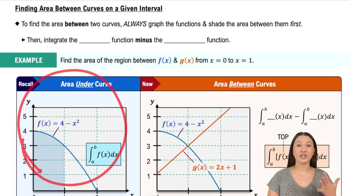
The area enclosed by polar curves is found using the integral formula (1/2)∫(r(θ))^2 dθ. For regions bounded by two curves, the area is the integral of the difference of their squared radii over the interval between intersection points.