
Identify the integral to solve: \(\int \frac{e^{x}}{4e^{x} + 6} \, dx\).
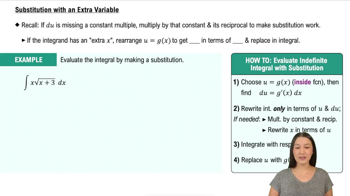
Notice that the denominator is a linear function of \(e^{x}\). This suggests using a substitution where \(u = 4e^{x} + 6\).
Compute the derivative of \(u\) with respect to \(x\): \(\frac{du}{dx} = 4e^{x}\). Rearranging, we get \(e^{x} dx = \frac{du}{4}\).
Rewrite the integral in terms of \(u\): replace \(e^{x} dx\) with \(\frac{du}{4}\) and the denominator with \(u\), so the integral becomes \(\int \frac{1}{u} \cdot \frac{du}{4} = \frac{1}{4} \int \frac{1}{u} \, du\).
Integrate \(\frac{1}{u}\) with respect to \(u\) to get \(\ln|u|\), then substitute back \(u = 4e^{x} + 6\) to express the answer in terms of \(x\).
Verified video answer for a similar problem:
This video solution was recommended by our tutors as helpful for the problem above
Video duration:
2m
Play a video:
0 Comments
Key Concepts
Here are the essential concepts you must grasp in order to answer the question correctly.
Integration by Substitution
Integration by substitution is a method used to simplify integrals by changing variables. It involves identifying a part of the integrand whose derivative also appears in the integral, allowing the integral to be rewritten in terms of a new variable, making it easier to solve.
Exponential functions have the form e^x, where e is Euler's number. Their derivatives and integrals are unique because the derivative of e^x is itself, which often simplifies integration problems involving exponential terms.
Rational functions are ratios of polynomials or expressions involving variables. Integrating rational functions often requires algebraic manipulation or substitution to rewrite the integral into a more manageable form, especially when the denominator contains expressions related to the numerator.