

Ch. 7 - Logarithmic, Exponential Functions, and Hyperbolic Functions
Briggs - Calculus: Early Transcendentals 3rd Edition
Briggs3rd EditionCalculus: Early TranscendentalsISBN: 9780136847243Not the one you use?Change textbook
Chapter 7, Problem 7.RE.4

2–9. Integrals Evaluate the following integrals.


∫₁⁴ (10^{√x} / √x) dx

Verified step by step guidance
1
Identify the integral to be solved: \(\int_1^4 \frac{10^{\sqrt{x}}}{\sqrt{x}} \, dx\).
Use the substitution method by letting \(t = \sqrt{x}\), which implies \(x = t^2\).
Calculate the differential \(dx\) in terms of \(dt\): since \(x = t^2\), then \(dx = 2t \, dt\).
Rewrite the integral in terms of \(t\): substitute \(\sqrt{x} = t\) and \(dx = 2t \, dt\) into the integral, and adjust the limits accordingly (when \(x=1\), \(t=1\); when \(x=4\), \(t=2\)).
Simplify the integral expression after substitution and set it up for integration with respect to \(t\).

Verified video answer for a similar problem:

This video solution was recommended by our tutors as helpful for the problem above.
Video duration:
3m
Was this helpful?

Key Concepts

Here are the essential concepts you must grasp in order to answer the question correctly.

Definite Integrals

A definite integral calculates the net area under a curve between two specific points, called limits of integration. It results in a numerical value representing the accumulation of quantities, such as area or total change, over the interval.
Recommended video:
05:43
Definition of the Definite Integral

Substitution Method

The substitution method simplifies integrals by changing variables to transform a complex integral into a more manageable form. It involves identifying a part of the integrand as a new variable and rewriting the integral in terms of this variable.
Recommended video:
07:33
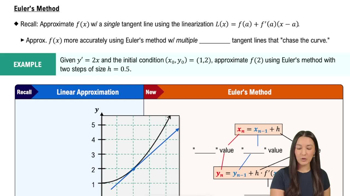
Euler's Method

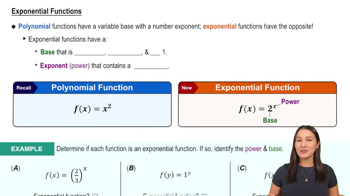
Exponential Functions with Variable Exponents

Exponential functions where the exponent is a function of the variable, like 10^{√x}, require careful handling during integration. Understanding how to differentiate and integrate such functions often involves using substitution and properties of logarithms.
Recommended video:
6:13
Exponential Functions