Ch. 2 - Limits
Briggs - Calculus: Early Transcendentals 3rd Edition
Briggs3rd EditionCalculus: Early TranscendentalsISBN: 9780136847243Not the one you use?Change textbook
Chapter 2, Problem 99

Evaluate lim x→1 3√x − 1 / x (Hint: x−1=(3√x)^3−1^3.)

Verified step by step guidance
1
Recognize that the problem involves evaluating a limit as \( x \to 1 \) of the expression \( \frac{\sqrt[3]{x} - 1}{x - 1} \).
Use the hint provided: \( x - 1 = (\sqrt[3]{x})^3 - 1^3 \). This suggests using the difference of cubes formula: \( a^3 - b^3 = (a-b)(a^2 + ab + b^2) \).
Set \( a = \sqrt[3]{x} \) and \( b = 1 \). Then, \( a^3 - b^3 = (\sqrt[3]{x})^3 - 1^3 = x - 1 \).
Rewrite the expression using the difference of cubes: \( x - 1 = (\sqrt[3]{x} - 1)(\sqrt[3]{x}^2 + \sqrt[3]{x} \cdot 1 + 1^2) \).
Substitute this back into the limit expression: \( \frac{\sqrt[3]{x} - 1}{x - 1} = \frac{\sqrt[3]{x} - 1}{(\sqrt[3]{x} - 1)(\sqrt[3]{x}^2 + \sqrt[3]{x} + 1)} \), and simplify to evaluate the limit.

Verified video answer for a similar problem:

This video solution was recommended by our tutors as helpful for the problem above.
Video duration:
4m
Was this helpful?

Key Concepts

Here are the essential concepts you must grasp in order to answer the question correctly.

Limits

In calculus, a limit is a fundamental concept that describes the behavior of a function as its input approaches a certain value. It helps in understanding the function's value at points where it may not be explicitly defined. Evaluating limits is crucial for determining continuity, derivatives, and integrals.
Recommended video:
05:50
One-Sided Limits

Factoring and Rationalization

Factoring involves rewriting an expression as a product of its factors, which can simplify the evaluation of limits. In this case, the hint suggests using the difference of cubes formula to factor the expression. Rationalization is a technique used to eliminate roots from the denominator, making it easier to compute limits.
Recommended video:
6:04
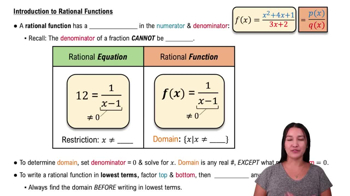
Intro to Rational Functions

The Difference of Cubes Formula

The difference of cubes formula states that a³ - b³ = (a - b)(a² + ab + b²). This formula is useful for simplifying expressions where one term is a cube, as it allows us to factor the expression and potentially cancel terms, facilitating the evaluation of limits.
Recommended video:
05:59
The Power Rule: Negative & Rational Exponents Example 2