Definite integrals Evaluate the following integrals using the Fundamental Theorem of Calculus
β«ββ΄ (π β 2)/βπ dπ
Verified step by step guidance
1
Step 1: Recognize that the integral β«ββ΄ (π β 2)/βπ dπ can be simplified by breaking the integrand into separate terms. Rewrite the integrand as (π/βπ) - (2/βπ). This simplifies to βπ - 2/βπ.
Step 2: Split the integral into two separate integrals: β«ββ΄ βπ dπ - β«ββ΄ (2/βπ) dπ. This allows us to evaluate each term individually.
Step 3: For the first integral β«ββ΄ βπ dπ, rewrite βπ as π^(1/2). Use the power rule for integration: β«πβΏ dπ = (π^(n+1))/(n+1) + C, where n β -1. Apply this rule to find the antiderivative of π^(1/2).
Step 4: For the second integral β«ββ΄ (2/βπ) dπ, rewrite 2/βπ as 2π^(-1/2). Again, use the power rule for integration to find the antiderivative of π^(-1/2).
Step 5: Apply the Fundamental Theorem of Calculus to both antiderivatives. Evaluate the antiderivatives at the upper limit (π = 4) and subtract the value at the lower limit (π = 1). Combine the results to find the value of the definite integral.
Verified video answer for a similar problem:
This video solution was recommended by our tutors as helpful for the problem above
Video duration:
6m
Play a video:
0 Comments
Key Concepts
Here are the essential concepts you must grasp in order to answer the question correctly.
Definite Integrals
Definite integrals represent the signed area under a curve between two specified limits. They are calculated using the integral symbol with lower and upper bounds, indicating the interval over which the function is evaluated. The result of a definite integral is a numerical value that quantifies this area, which can be interpreted in various contexts, such as physics and economics.
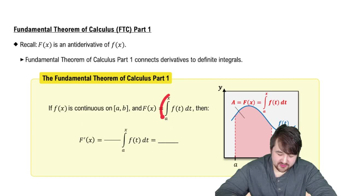
The Fundamental Theorem of Calculus links the concept of differentiation with integration, providing a method to evaluate definite integrals. It states that if a function is continuous on an interval, then the integral of its derivative over that interval equals the difference in the values of the original function at the endpoints. This theorem allows for the computation of definite integrals by finding antiderivatives.
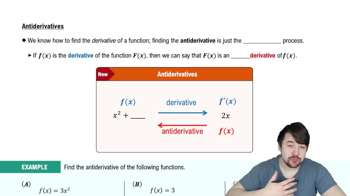
An antiderivative of a function is another function whose derivative is the original function. Finding an antiderivative is a key step in evaluating definite integrals using the Fundamental Theorem of Calculus. For example, if F(x) is an antiderivative of f(x), then the definite integral from a to b can be computed as F(b) - F(a), providing a straightforward way to find the area under the curve.