
Start by examining the integral \( \int \frac{x + 4}{x^{2} + 8x + 25} \, dx \). Notice that the denominator is a quadratic expression, so consider completing the square to simplify it.
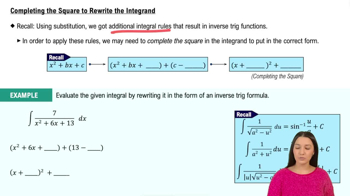
Rewrite the denominator \( x^{2} + 8x + 25 \) by completing the square: \( x^{2} + 8x + 25 = (x + 4)^{2} + 9 \). This form will help in recognizing the integral structure.
Split the integral into two parts by expressing the numerator in terms of \( (x + 4) \): \( \int \frac{x + 4}{(x + 4)^{2} + 9} \, dx \). This suggests a substitution where \( u = x + 4 \).
Use the substitution \( u = x + 4 \), so \( du = dx \). The integral becomes \( \int \frac{u}{u^{2} + 9} \, du \). This integral can be approached by recognizing it as a rational function where the numerator is the derivative of the denominator's inner function.
To solve \( \int \frac{u}{u^{2} + 9} \, du \), consider using the substitution \( w = u^{2} + 9 \), so \( dw = 2u \, du \). Rewrite the integral accordingly and split it if necessary to integrate using logarithmic and arctangent functions.
Verified video answer for a similar problem:
This video solution was recommended by our tutors as helpful for the problem above
Video duration:
2m
Play a video:
0 Comments
Key Concepts
Here are the essential concepts you must grasp in order to answer the question correctly.
Integration of Rational Functions
This involves integrating functions expressed as the ratio of two polynomials. Techniques often include polynomial division, substitution, or rewriting the integrand to simplify the integral into a more manageable form.
Completing the square transforms a quadratic expression into the form (x + a)² + b, which is useful for recognizing standard integral forms, especially those involving inverse trigonometric functions or logarithms.
Substitution simplifies integrals by changing variables to reduce the integral into a basic form. For example, setting u = x + constant or u = quadratic expression helps in integrating complex rational functions.