Ch. 9 - Differential Equations
Briggs - Calculus: Early Transcendentals 3rd Edition
Briggs3rd EditionCalculus: Early TranscendentalsISBN: 9780136847243Not the one you use?Change textbook
Chapter 9, Problem 9.1.1a

Consider the differential equation y'(t)+9y(t)=10.
a. How many arbitrary constants appear in the general solution of the differential equation?

Verified step by step guidance
1
Identify the type of differential equation given. The equation is \(y'(t) + 9y(t) = 10\), which is a first-order linear ordinary differential equation.
Recall that the general solution of a first-order ordinary differential equation typically contains one arbitrary constant because it involves one integration step.
Understand that the arbitrary constant arises from integrating the differential equation to find the general solution, representing the family of all possible solutions.
Therefore, the number of arbitrary constants in the general solution corresponds to the order of the differential equation, which is 1 in this case.
Conclude that the general solution of the given differential equation will contain exactly one arbitrary constant.

Verified video answer for a similar problem:

This video solution was recommended by our tutors as helpful for the problem above.
Video duration:
58s
Was this helpful?

Key Concepts

Here are the essential concepts you must grasp in order to answer the question correctly.

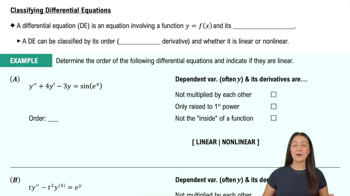
First-Order Linear Differential Equations

A first-order linear differential equation has the form y' + p(t)y = q(t). Its general solution combines the homogeneous solution and a particular solution. Understanding this form helps in solving and analyzing the behavior of solutions.
Recommended video:
07:39
Classifying Differential Equations

General Solution and Arbitrary Constants

The general solution of an nth-order differential equation contains n arbitrary constants, reflecting the family of all possible solutions. For a first-order equation, there is exactly one arbitrary constant representing initial conditions.
Recommended video:
02:16
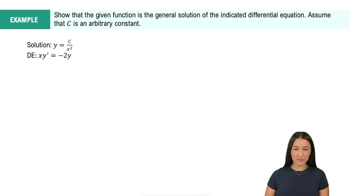
Verifying Solutions of Differential Equations Example 4

Homogeneous vs. Particular Solutions

The homogeneous solution solves the equation when the right side is zero, while the particular solution satisfies the entire nonhomogeneous equation. The general solution is the sum of both, with arbitrary constants appearing only in the homogeneous part.
Recommended video:
05:13
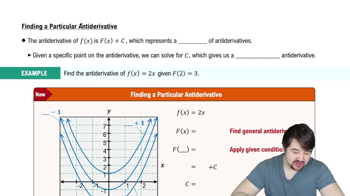
Finding a Particular Antiderivative
Related Practice
Textbook Question

[Use of Tech] Analysis of a separable equation Consider the differential equation yy'(t) = ½eᵗ + t and carry out the following analysis.

a. Find the general solution of the equation and express it explicitly as a function of t in two cases: y > 0 and y < 0.

44
views
Textbook Question

33–36. {Use of Tech} Computing Euler approximations Use a calculator or computer program to carry out the following steps.

a. Approximate the value of y(T) using Euler’s method with the given time step on the interval [0,T].


y′(t) = t/y, y(0) = 4; Δt = 0.1, T = 2; y(t) = √(t² + 16)

43
views
Textbook Question

A physiological model A common assumption in modeling drug assimilation is that the blood volume in a person is a single compartment that behaves like a stirred tank. Suppose the blood volume is a four-liter tank that initially has a zero concentration of a particular drug. At time t = 0, an intravenous line is inserted into a vein (into the tank) that carries a drug solution with a concentration of 500 mg/L. The inflow rate is 0.06 L/min. Assume the drug is quickly mixed thoroughly in the blood and that the volume of blood remains constant.

a. Write an initial value problem that models the mass of the drug in the blood, for t ≥ 0.

48
views
Textbook Question

38–43. Equilibrium solutions A differential equation of the form y′(t)=f(y) is said to be autonomous (the function f depends only on y). The constant function y=y0 is an equilibrium solution of the equation provided f(y0)=0 (because then y'(t)=0 and the solution remains constant for all t). Note that equilibrium solutions correspond to horizontal lines in the direction field. Note also that for autonomous equations, the direction field is independent of t. Carry out the following analysis on the given equations.

a. Find the equilibrium solutions.


y′(t) = 2y + 4

73
views
Textbook Question

46–48. Analyzing models The following models were discussed in Section 9.1 and reappear in later sections of this chapter. In each case, carry out the indicated analysis using direction fields.

Drug infusion The delivery of a drug (such as an antibiotic) through an intravenous line may be modeled by the differential equation m′(t)+km(t)=I, where m(t) is the mass of the drug in the blood at time t≥0, K is a constant that describes the rate at which the drug is absorbed, and I is the infusion rate. Let I=10mg/hr and k=0.05 hr^−1.

a. Draw the direction field, for 0≤t≤100, 0≤y≤600.

42
views
Textbook Question

38–43. Equilibrium solutions A differential equation of the form y′(t)=f(y) is said to be autonomous (the function f depends only on y). The constant function y=y0 is an equilibrium solution of the equation provided f(y0)=0 (because then y'(t)=0 and the solution remains constant for all t). Note that equilibrium solutions correspond to horizontal lines in the direction field. Note also that for autonomous equations, the direction field is independent of t. Carry out the following analysis on the given equations.

a. Find the equilibrium solutions. 


y′(t) = 6 - 2y

96
views