Does the function y(t) = 2t satisfy the differential equation y'''(t) + y'(t) = 2?
Table of contents
- 0. Functions7h 55m
- Introduction to Functions18m
- Piecewise Functions10m
- Properties of Functions9m
- Common Functions1h 8m
- Transformations5m
- Combining Functions27m
- Exponent rules32m
- Exponential Functions28m
- Logarithmic Functions24m
- Properties of Logarithms36m
- Exponential & Logarithmic Equations35m
- Introduction to Trigonometric Functions38m
- Graphs of Trigonometric Functions44m
- Trigonometric Identities47m
- Inverse Trigonometric Functions48m
- 1. Limits and Continuity2h 2m
- 2. Intro to Derivatives1h 33m
- 3. Techniques of Differentiation3h 18m
- 4. Applications of Derivatives2h 38m
- 5. Graphical Applications of Derivatives6h 2m
- 6. Derivatives of Inverse, Exponential, & Logarithmic Functions2h 37m
- 7. Antiderivatives & Indefinite Integrals1h 26m
- 8. Definite Integrals4h 44m
- 9. Graphical Applications of Integrals2h 27m
- 10. Physics Applications of Integrals 3h 16m
- 11. Integrals of Inverse, Exponential, & Logarithmic Functions2h 31m
- 12. Techniques of Integration7h 41m
- 13. Intro to Differential Equations2h 55m
- 14. Sequences & Series5h 36m
- 15. Power Series2h 19m
- 16. Parametric Equations & Polar Coordinates7h 58m
13. Intro to Differential Equations
Basics of Differential Equations
Problem 9.5.11
Textbook Question
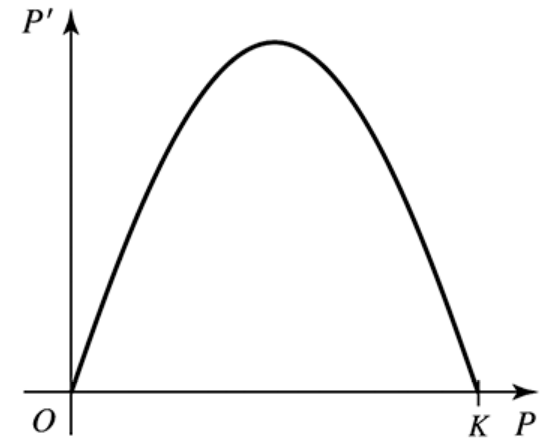
9–14. Growth rate functions Make a sketch of the population function P (as a function of time) that results from the following growth rate functions. Assume the population at time t = 0 begins at some positive value.

Verified step by step guidance1
Step 1: Understand the graph provided. The graph shows the growth rate function \(P'(t)\) plotted against the population \(P\). The curve starts at \(P=0\) with \(P'=0\), rises to a maximum positive growth rate at some intermediate population, and then decreases back to \(P'=0\) at \(P=K\).
Step 2: Interpret the meaning of \(P'\) in terms of population growth. Since \(P'(t)\) represents the rate of change of the population \(P\) with respect to time \(t\), positive values of \(P'\) mean the population is increasing, and negative values would mean the population is decreasing. Here, \(P'\) is zero at \(P=0\) and \(P=K\), and positive in between.
Step 3: Sketch the population function \(P(t)\) starting from a positive initial population \(P(0)\). Since \(P'(t)\) is positive for \$0 < P < K\(, the population will increase over time until it approaches \)K\(. At \)P=K\(, the growth rate \)P'$ is zero, so the population stabilizes and stops growing.
Step 4: Consider the shape of \(P(t)\). Because \(P'(t)\) increases then decreases as \(P\) approaches \(K\), the population growth rate accelerates initially, then slows down as it nears the carrying capacity \(K\). This suggests an S-shaped or logistic growth curve for \(P(t)\).
Step 5: Conclude that the population \(P(t)\) will start at a positive value, increase over time with a decreasing growth rate as it approaches \(K\), and eventually level off at \(P=K\), representing a stable equilibrium population.
Verified video answer for a similar problem:This video solution was recommended by our tutors as helpful for the problem above
Video duration:
2mPlay a video:
Was this helpful?
Key Concepts
Here are the essential concepts you must grasp in order to answer the question correctly.
Relationship Between a Function and Its Derivative
The derivative of a function represents its rate of change. In this problem, P' is the growth rate of the population P. Understanding how the sign and magnitude of P' affect the shape of P is crucial: where P' is positive, P increases; where P' is zero, P has critical points; and where P' is negative, P decreases.
Recommended video:
Derivatives of Other Trig Functions
Interpreting the Graph of the Growth Rate Function
The graph shows P' as a function of P, starting at zero at P=0, rising to a maximum, then returning to zero at P=K. This indicates that the growth rate increases with population up to a point, then decreases to zero at a carrying capacity K, suggesting logistic growth behavior.
Recommended video:
Graph of Sine and Cosine Function
Sketching Population Functions from Growth Rates
To sketch P(t) from P'(P), consider how the growth rate changes with population size. Starting from a positive initial population, P will increase when P' > 0, slow down as P' approaches zero, and stabilize at P=K where growth rate is zero. This results in an S-shaped logistic curve for P(t).
Recommended video:
Real World Application
Watch next
Master Classifying Differential Equations with a bite sized video explanation from Patrick
Start learningRelated Videos
Related Practice
Textbook Question
18
views