In Exercises 69 and 70, match each equation with its graph. Do not use a graphing device, and give reasons for your answer.
a. y = x⁴ b. y = x⁷ c. y = x¹⁰
<IMAGE>
Verified step by step guidance
1
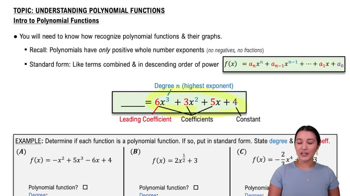
Step 1: Understand the general shape of the graphs for even and odd power functions. Even power functions like y = x^4 and y = x^10 have a U-shaped graph, while odd power functions like y = x^7 have an S-shaped graph.
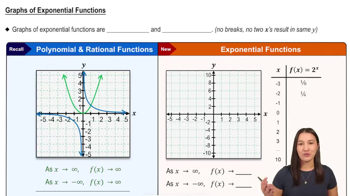
Step 2: Consider the end behavior of each function. For even powers, as x approaches positive or negative infinity, y approaches positive infinity. For odd powers, as x approaches positive infinity, y approaches positive infinity, and as x approaches negative infinity, y approaches negative infinity.
Step 3: Analyze the steepness of the graphs. Higher powers result in steeper graphs near the origin. Therefore, y = x^10 will be steeper than y = x^4, and y = x^7 will be steeper than lower odd powers.
Step 4: Identify the symmetry of the graphs. Even power functions are symmetric about the y-axis, while odd power functions are symmetric about the origin.
Step 5: Match each equation to its graph based on the characteristics discussed: symmetry, end behavior, and steepness. Use these properties to determine which graph corresponds to each equation without using a graphing device.
Verified video answer for a similar problem:
This video solution was recommended by our tutors as helpful for the problem above
Video duration:
2m
Play a video:
Was this helpful?
Key Concepts
Here are the essential concepts you must grasp in order to answer the question correctly.
Polynomial Functions
Polynomial functions are mathematical expressions involving variables raised to whole number powers, combined using addition, subtraction, and multiplication. The degree of the polynomial, determined by the highest power of the variable, influences its shape and behavior. For example, the function y = x⁴ is a polynomial of degree 4, which typically has a U-shaped graph that opens upwards.
The end behavior of a function describes how the function behaves as the input values approach positive or negative infinity. For even-degree polynomials like y = x⁴ and y = x¹⁰, the ends of the graph will rise in the same direction, while odd-degree polynomials like y = x⁷ will have opposite end behaviors. Understanding end behavior helps predict the graph's shape without plotting points.
Graphing techniques involve analyzing key features of a function, such as intercepts, symmetry, and critical points, to sketch its graph accurately. For polynomial functions, identifying whether the function is even or odd can reveal symmetry about the y-axis or origin, respectively. This knowledge aids in matching equations to their corresponding graphs by visualizing their characteristics.