How would you approximate e⁻⁰ᐧ⁶ using the Taylor series for eˣ?
Verified step by step guidance
1
Recall the Taylor series expansion for the exponential function \(e^{x}\) centered at 0, which is given by:
\[e^{x} = \sum_{n=0}^{\infty} \frac{x^{n}}{n!} = 1 + x + \frac{x^{2}}{2!} + \frac{x^{3}}{3!} + \cdots\]
To approximate \(e^{-0.6}\), substitute \(x = -0.6\) into the series:
\[e^{-0.6} = 1 + (-0.6) + \frac{(-0.6)^{2}}{2!} + \frac{(-0.6)^{3}}{3!} + \cdots\]
Decide how many terms of the series you want to use for the approximation. More terms generally mean a more accurate approximation. For example, you might use the first 4 or 5 terms.
Calculate each term up to the chosen number of terms by raising \(-0.6\) to the appropriate power and dividing by the factorial of the term's index. Remember that factorial \(n!\) is the product of all positive integers up to \(n\).
Sum all the calculated terms together to get the approximate value of \(e^{-0.6}\). This sum will be your Taylor series approximation.
Verified video answer for a similar problem:
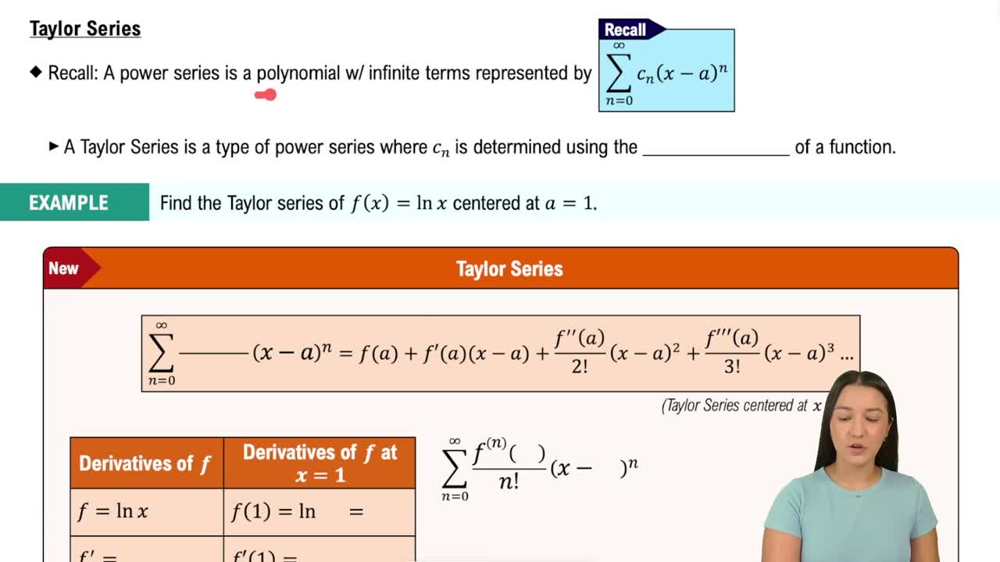
This video solution was recommended by our tutors as helpful for the problem above
Video duration:
2m
Play a video:
Was this helpful?
Key Concepts
Here are the essential concepts you must grasp in order to answer the question correctly.
Taylor Series Expansion
The Taylor series expresses a function as an infinite sum of terms calculated from the function's derivatives at a single point, usually zero. For eˣ, the series is ∑(xⁿ/n!) from n=0 to ∞, allowing approximation of eˣ by summing a finite number of terms.
To approximate e⁻⁰·⁶, substitute x = -0.6 into the Taylor series for eˣ. This involves raising -0.6 to successive powers and dividing by factorial terms, which accounts for the alternating signs and magnitude changes in the series.
The accuracy of the approximation depends on the number of terms used. Taylor series for eˣ converges for all real x, and truncating after several terms yields a close estimate. Understanding the remainder term helps gauge the approximation's precision.