Ch. 10 - Sequences and Infinite Series
Briggs - Calculus: Early Transcendentals 3rd Edition
Briggs3rd EditionCalculus: Early TranscendentalsISBN: 9780136847243Not the one you use?Change textbook
Chapter 10, Problem 10.6.65a

Explain why or why not Determine whether the following statements are true and give an explanation or counterexample.


a. A series that converges must converge absolutely.

Verified step by step guidance
1
Recall the definitions: A series \( \sum a_n \) converges absolutely if \( \sum |a_n| \) converges, and it converges conditionally if \( \sum a_n \) converges but \( \sum |a_n| \) diverges.
Understand that absolute convergence implies convergence, but the converse is not necessarily true.
Consider the alternating harmonic series \( \sum (-1)^{n+1} \frac{1}{n} \), which converges by the Alternating Series Test but does not converge absolutely because \( \sum \frac{1}{n} \) diverges.
This example shows that a series can converge without converging absolutely, so the statement 'A series that converges must converge absolutely' is false.
Therefore, the correct conclusion is that convergence does not imply absolute convergence; some series converge conditionally.

Verified video answer for a similar problem:

This video solution was recommended by our tutors as helpful for the problem above.
Video duration:
1m
Was this helpful?

Key Concepts

Here are the essential concepts you must grasp in order to answer the question correctly.

Convergence of a Series

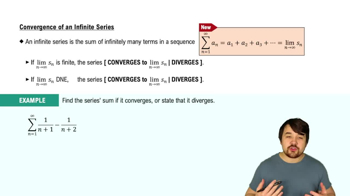
A series converges if the sequence of its partial sums approaches a finite limit. This means the sum of infinitely many terms settles to a specific value, indicating the series has a well-defined total.
Recommended video:
06:52
Convergence of an Infinite Series

Absolute Convergence

A series converges absolutely if the series formed by taking the absolute values of its terms also converges. Absolute convergence guarantees convergence and often simplifies analysis, especially for series with both positive and negative terms.
Recommended video:
07:51
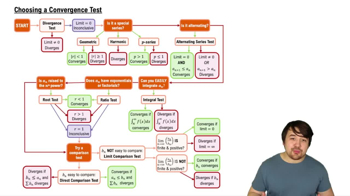
Choosing a Convergence Test

Conditional Convergence and Counterexamples

A series is conditionally convergent if it converges but does not converge absolutely. The alternating harmonic series is a classic example, showing that convergence does not imply absolute convergence, which is crucial for evaluating the truth of the statement.
Recommended video:
07:51
Choosing a Convergence Test
Related Practice
Textbook Question

41–44. {Use of Tech} Remainders and estimates Consider the following convergent series.


a. Find an upper bound for the remainder in terms of n.


43. ∑ (k = 1 to ∞) 1 / 3ᵏ

154
views

Textbook Question

72–75. {Use of Tech} Practical sequences

Consider the following situations that generate a sequence


a.Write out the first five terms of the sequence.


Drug elimination

Jack took a 200-mg dose of a pain killer at midnight. Every hour, 5% of the drug is washed out of his bloodstream. Let dₙ be the amount of drug in Jack’s blood n hours after the drug was taken, where d₀ = 200mg.

43
views
Textbook Question

71. Evaluating an infinite series two ways

Evaluate the series

∑ (k = 1 to ∞) (4 / 3ᵏ – 4 / 3ᵏ⁺¹) two ways.

a. Use a telescoping series argument.

84
views
Textbook Question

Explain why or why not

Determine whether the following statements are true and give an explanation or counterexample.

a. If the Limit Comparison Test can be applied successfully to a given series with a certain comparison series, the Comparison Test also works with the same comparison series.

46
views
Textbook Question

{Use of Tech} Periodic dosing

Many people take aspirin on a regular basis as a preventive measure for heart disease. Suppose a person takes 80 mg of aspirin every 24 hours. Assume aspirin has a half-life of 24 hours; that is, every 24 hours, half of the drug in the blood is eliminated.


a.Find a recurrence relation for the sequence {dₙ} that gives the amount of drug in the blood after the nᵗʰ dose, where d₁ = 80.

44
views
Textbook Question

57–60. Heights of bouncing balls A ball is thrown upward to a height of hₒ meters. After each bounce, the ball rebounds to a fraction r of its previous height. Let hₙ be the height after the nth bounce. Consider the following values of hₒ and r.


a. Find the first four terms of the sequence of heights {hₙ}.


h₀ = 20,r = 0.5

52
views