What test is advisable if a series involves a factorial term?
Verified step by step guidance
1
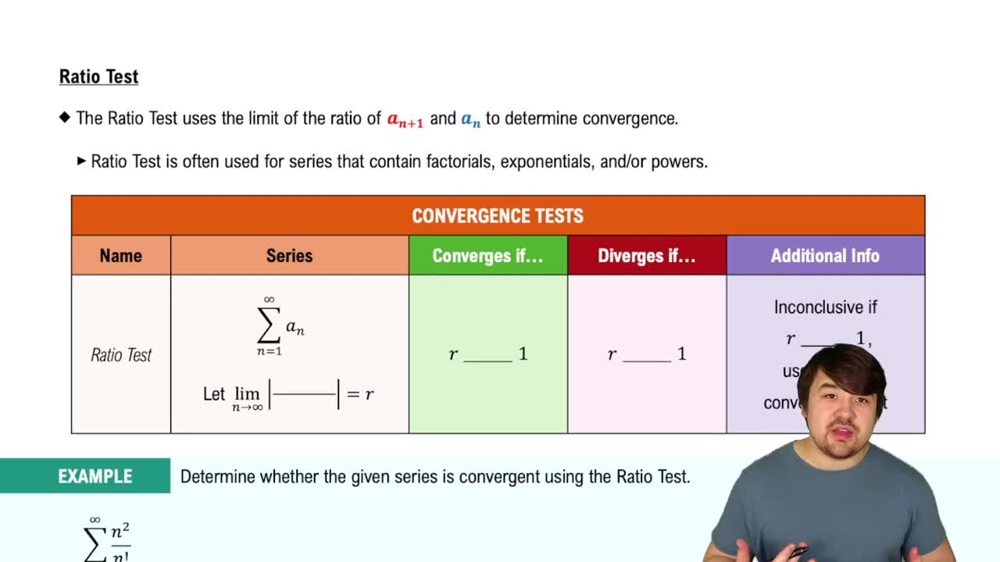
When a series involves factorial terms, it is often advisable to use the Ratio Test to determine convergence or divergence.
The Ratio Test involves examining the limit of the absolute value of the ratio of consecutive terms: \(\lim_{n \to \infty} \left| \frac{a_{n+1}}{a_n} \right|\).
For a series with terms involving factorials, this test simplifies the factorial expressions because factorials cancel nicely when taking ratios of consecutive terms.
If the limit from the Ratio Test is less than 1, the series converges absolutely; if it is greater than 1, the series diverges; and if it equals 1, the test is inconclusive.
Therefore, the Ratio Test is the most effective and commonly used test for series with factorial terms.
Verified video answer for a similar problem:
This video solution was recommended by our tutors as helpful for the problem above
Video duration:
4m
Play a video:
0 Comments
Key Concepts
Here are the essential concepts you must grasp in order to answer the question correctly.
Factorial Terms in Series
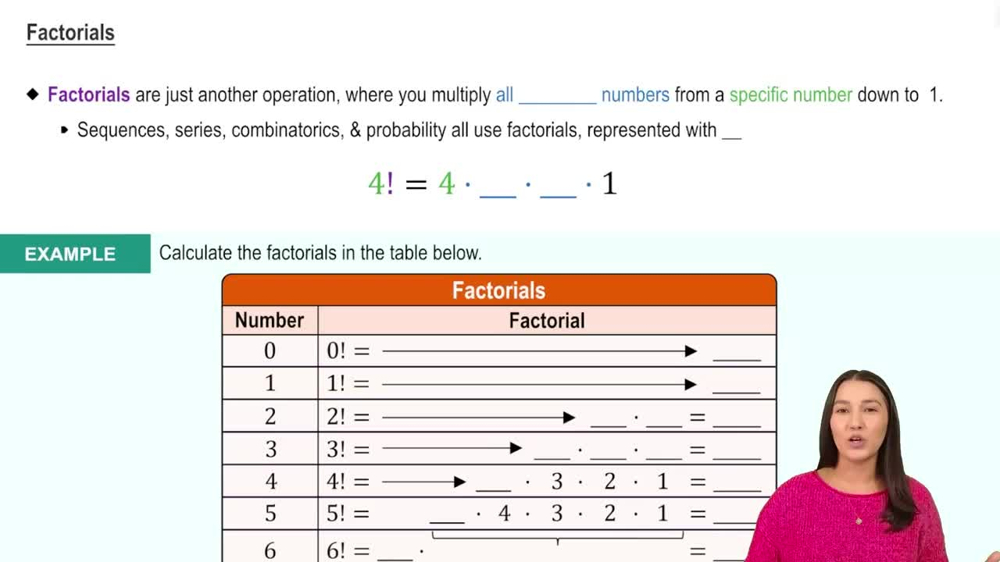
Factorial terms, denoted by n!, grow very rapidly and often appear in series related to permutations or combinations. Recognizing factorials in series helps determine the appropriate convergence test, as their growth rate affects the behavior of the series.
The Ratio Test is used to determine the convergence of a series by examining the limit of the absolute value of the ratio of consecutive terms. It is especially effective for series with factorials or exponential terms because it simplifies the factorial expressions and reveals convergence behavior.
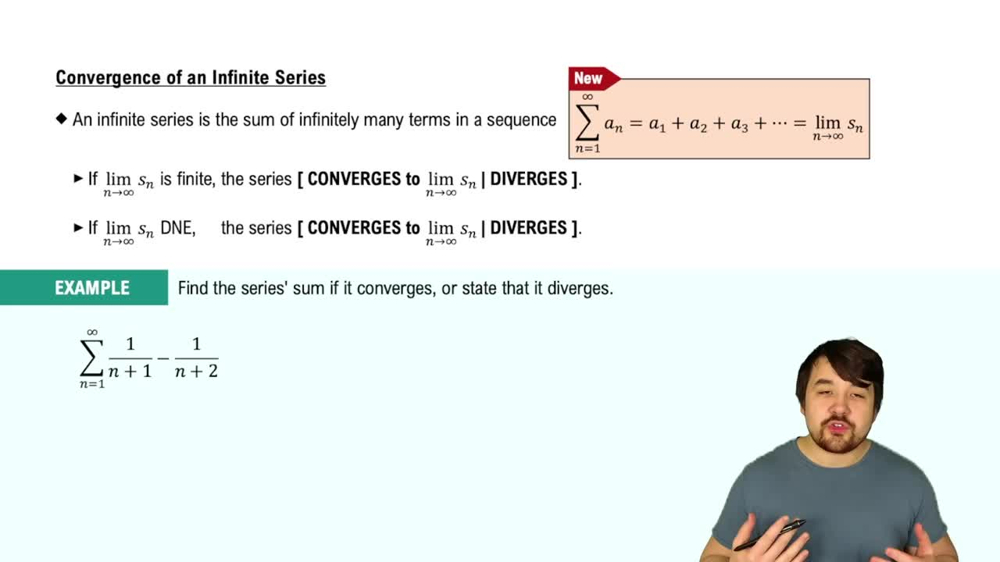
Understanding when an infinite series converges or diverges is fundamental in calculus. Convergence means the sum approaches a finite value, and tests like the Ratio Test help decide this, particularly when terms involve complex expressions like factorials.