Ch. 10 - Sequences and Infinite Series
Briggs - Calculus: Early Transcendentals 3rd Edition
Briggs3rd EditionCalculus: Early TranscendentalsISBN: 9780136847243Not the one you use?Change textbook
Chapter 10, Problem 10.5.21

9–36. Comparison tests Use the Comparison Test or the Limit Comparison Test to determine whether the following series converge.


∑ (k = 1 to ∞) ((3k³ + 4)(7k² + 1)) / ((2k³ + 1)(4k³ − 1))

Verified step by step guidance
1
First, identify the general term of the series: \(a_k = \frac{(3k^{3} + 4)(7k^{2} + 1)}{(2k^{3} + 1)(4k^{3} - 1)}\).
Next, analyze the behavior of \(a_k\) for large \(k\) by focusing on the highest degree terms in numerator and denominator: numerator behaves like \(3k^{3} \times 7k^{2} = 21k^{5}\), denominator behaves like \(2k^{3} \times 4k^{3} = 8k^{6}\).
Simplify the dominant term ratio for large \(k\): \(a_k \sim \frac{21k^{5}}{8k^{6}} = \frac{21}{8k}\), which suggests \(a_k\) behaves like \(\frac{C}{k}\) for some constant \(C\) as \(k \to \infty\).
Choose a comparison series \(b_k = \frac{1}{k}\), which is a \(p\)-series with \(p=1\), known to diverge.
Apply the Limit Comparison Test by computing \(\lim_{k \to \infty} \frac{a_k}{b_k} = \lim_{k \to \infty} a_k \times k\), and analyze the limit to determine if it is finite and positive, which will indicate whether \(\sum a_k\) converges or diverges.

Verified video answer for a similar problem:

This video solution was recommended by our tutors as helpful for the problem above.
Video duration:
3m
Was this helpful?

Key Concepts

Here are the essential concepts you must grasp in order to answer the question correctly.

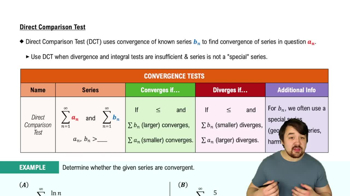
Comparison Test

The Comparison Test determines the convergence of a series by comparing it to a second series with known behavior. If the terms of the given series are smaller than those of a convergent series, it also converges. Conversely, if the terms are larger than those of a divergent series, it diverges. This test requires finding a suitable comparison series.
Recommended video:
09:25
Direct Comparison Test

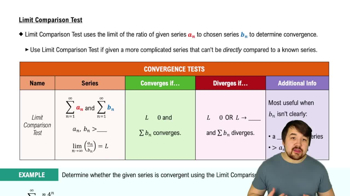
Limit Comparison Test

The Limit Comparison Test involves taking the limit of the ratio of the terms of two series. If this limit is a positive finite number, both series either converge or diverge together. This test is useful when direct comparison is difficult but the terms behave similarly for large indices.
Recommended video:
07:45
Limit Comparison Test

Asymptotic Behavior of Rational Functions

Analyzing the dominant terms in the numerator and denominator of rational expressions helps simplify the general term of a series. For large k, lower-degree terms become negligible, allowing approximation of the term’s behavior. This simplification is crucial for choosing an appropriate comparison series.
Recommended video:
5:50
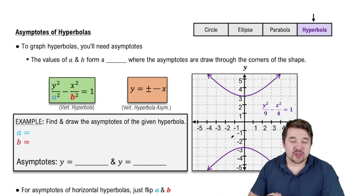
Asymptotes of Hyperbolas