Finding derivatives from a table Find the values of the following derivatives using the table. <IMAGE>
b. d/dx ((f(x) / g(x)) |x=
Verified step by step guidance
1
Step 1: Identify the functions f(x) and g(x) from the table provided. Note their values and any derivatives given at specific points.
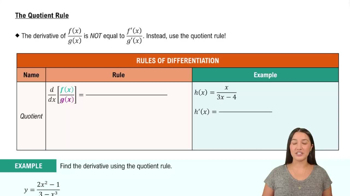
Step 2: Recall the quotient rule for derivatives, which states that if you have a function h(x) = f(x)/g(x), then the derivative h'(x) is given by: \( h'(x) = \frac{g(x)f'(x) - f(x)g'(x)}{(g(x))^2} \).
Step 3: Substitute the values of f(x), f'(x), g(x), and g'(x) at the point x = a from the table into the quotient rule formula.
Step 4: Simplify the expression obtained in Step 3 by performing the necessary arithmetic operations.
Step 5: Ensure that the denominator (g(x))^2 is not zero at x = a to avoid division by zero, and verify the final expression for correctness.
Verified video answer for a similar problem:
This video solution was recommended by our tutors as helpful for the problem above
Video duration:
4m
Play a video:
0 Comments
Key Concepts
Here are the essential concepts you must grasp in order to answer the question correctly.
Derivatives
A derivative represents the rate of change of a function with respect to a variable. It is a fundamental concept in calculus that provides information about the slope of the tangent line to the curve of the function at any given point. Understanding how to compute derivatives is essential for analyzing the behavior of functions.
The Quotient Rule is a formula used to find the derivative of a function that is the ratio of two other functions. Specifically, if you have a function h(x) = f(x) / g(x), the derivative h'(x) is given by (g(x)f'(x) - f(x)g'(x)) / (g(x))^2. This rule is crucial when dealing with derivatives of fractions.
Evaluating a derivative at a specific point involves substituting the value of the variable into the derivative function. This process provides the slope of the tangent line to the function at that particular point, which is important for understanding the function's behavior in that vicinity.


 4:17 minutes
 Verified step by step guidance

 05:44
05:44