First, identify the function y given in the problem. Here, y = e^(tan(x)) * (tan(x) - 1).
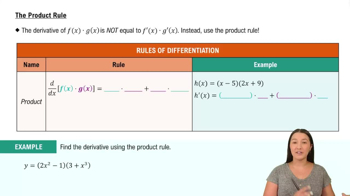
To find y', the derivative of y with respect to x, apply the product rule. The product rule states that if you have a function u(x) * v(x), then the derivative is u'(x) * v(x) + u(x) * v'(x).
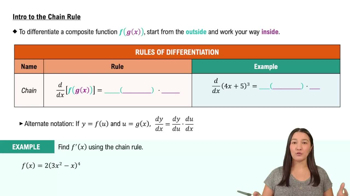
Let u(x) = e^(tan(x)) and v(x) = tan(x) - 1. Find the derivative of u(x), which involves the chain rule. The chain rule states that if you have a composite function f(g(x)), then the derivative is f'(g(x)) * g'(x).
Calculate u'(x): The derivative of e^(tan(x)) is e^(tan(x)) * sec^2(x), because the derivative of tan(x) is sec^2(x).
Calculate v'(x): The derivative of tan(x) - 1 is sec^2(x), since the derivative of tan(x) is sec^2(x) and the derivative of a constant is 0.
Verified video answer for a similar problem:
This video solution was recommended by our tutors as helpful for the problem above
Video duration:
3m
Play a video:
Was this helpful?
Key Concepts
Here are the essential concepts you must grasp in order to answer the question correctly.
Differentiation
Differentiation is the process of finding the derivative of a function, which represents the rate of change of the function with respect to its variable. In this context, we need to apply differentiation rules to the given function y = e^(tan x) (tan x - 1) to find y'. This involves using the product rule and the chain rule, as the function is a product of two functions.
The product rule is a formula used to differentiate products of two functions. It states that if you have two functions u(x) and v(x), the derivative of their product is given by u'v + uv'. In the case of y = e^(tan x) (tan x - 1), we will apply the product rule to differentiate the two components of the function.
The chain rule is a fundamental technique in calculus for differentiating composite functions. It states that if a function y is composed of another function u, then the derivative of y with respect to x is the derivative of y with respect to u multiplied by the derivative of u with respect to x. In this problem, we will use the chain rule to differentiate e^(tan x) since tan x is itself a function of x.