Exercises 5–10 refer to the function f(x) = { x² − 1, −1 ≤ x < 0 2x, 0 < x < 1 1, x = 1 −2x + 4, 1 < x < 2 0, 2 < x < 3 graphed in the accompanying figure. <IMAGE> At what values of x is f continuous?
Verified step by step guidance
1
Identify the points where the function changes its expression. These points are x = -1, x = 0, x = 1, and x = 2.
Check the continuity at each of these points by ensuring the left-hand limit, right-hand limit, and the function value at the point are equal.
For x = 0, evaluate the left-hand limit using the expression x² - 1 for x approaching 0 from the left, and the right-hand limit using 2x for x approaching 0 from the right. Compare these limits with the function value at x = 0.
For x = 1, evaluate the left-hand limit using 2x for x approaching 1 from the left, and the right-hand limit using -2x + 4 for x approaching 1 from the right. Compare these limits with the function value at x = 1.
For x = 2, evaluate the left-hand limit using -2x + 4 for x approaching 2 from the left, and the right-hand limit using 0 for x approaching 2 from the right. Compare these limits with the function value at x = 2.
Verified video answer for a similar problem:
This video solution was recommended by our tutors as helpful for the problem above
Video duration:
2m
Play a video:
Was this helpful?
Key Concepts
Here are the essential concepts you must grasp in order to answer the question correctly.
Continuity of Functions
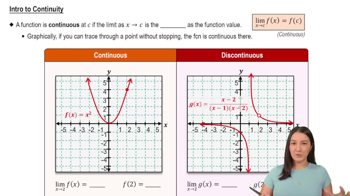
A function is continuous at a point if the limit of the function as it approaches that point equals the function's value at that point. This means there are no breaks, jumps, or holes in the graph of the function at that point. For piecewise functions, continuity must be checked at the boundaries where the pieces meet.
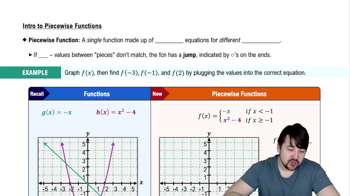
Piecewise functions are defined by different expressions based on the input value. In this case, the function f(x) has different formulas for different intervals of x. Understanding how to evaluate these functions at specific points and how they transition between intervals is crucial for analyzing their continuity.
Limits are fundamental in calculus for understanding the behavior of functions as they approach a certain point. To determine continuity, one must evaluate the left-hand limit and the right-hand limit at the boundaries of the piecewise function. If both limits exist and are equal to the function's value at that point, the function is continuous there.