
Ch. 11 - Power Series
Briggs - Calculus: Early Transcendentals 3rd Edition
Briggs3rd EditionCalculus: Early TranscendentalsISBN: 9780136847243Not the one you use?Change textbook
Chapter 11, Problem 11.1.65b

Explain why or why not Determine whether the following statements are true and give an explanation or counterexample.


b. Let f(x)=x⁵−1 The Taylor polynomial for f of order 10 centered at 0 is f itself.

Verified step by step guidance
1
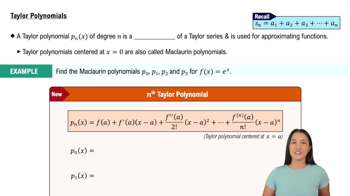
Recall that the Taylor polynomial of order \(n\) for a function \(f(x)\) centered at \(a\) is given by the sum of the first \(n+1\) terms of the Taylor series expansion: \[T_n(x) = \sum_{k=0}^n \frac{f^{(k)}(a)}{k!} (x - a)^k\]
Since the function is \(f(x) = x^5 - 1\) and the center is \(a = 0\), find the derivatives of \(f\) up to order 10. Note that derivatives of order higher than 5 will be zero because \(x^5\) is a polynomial of degree 5.
Write out the Taylor polynomial of order 10 centered at 0 by substituting the derivatives into the formula. Because derivatives of order greater than 5 are zero, terms with powers higher than 5 will not appear in the polynomial.
Compare the Taylor polynomial of order 10 with the original function \(f(x) = x^5 - 1\). Since the Taylor polynomial includes all terms up to degree 10 but the function is degree 5, the polynomial will match the function exactly (no higher degree terms exist).
Conclude that the Taylor polynomial of order 10 centered at 0 is indeed the function itself because the function is a polynomial of degree less than or equal to 10, so the Taylor polynomial captures the entire function.

Verified video answer for a similar problem:

This video solution was recommended by our tutors as helpful for the problem above.
Video duration:
4m
Was this helpful?

Key Concepts

Here are the essential concepts you must grasp in order to answer the question correctly.

Taylor Polynomial and Taylor Series

A Taylor polynomial of order n for a function f at a point a is a polynomial approximation using derivatives of f up to the nth order at a. It matches the function and its derivatives up to order n at that point, providing a local approximation of f near a.
Recommended video:
07:00
Taylor Polynomials

Degree of a Polynomial and Taylor Polynomial Order

If f is a polynomial of degree m, its Taylor polynomial of order n ≥ m centered at any point equals f itself. This is because all derivatives of order higher than m are zero, so the Taylor polynomial captures the entire polynomial exactly.
Recommended video:
07:00
Taylor Polynomials

Application to f(x) = x⁵ − 1 and Order 10 Taylor Polynomial

For f(x) = x⁵ − 1, a polynomial of degree 5, the Taylor polynomial of order 10 centered at 0 includes all terms up to x¹⁰. Since f has no terms beyond degree 5, the Taylor polynomial of order 10 equals f exactly, making the statement true.
Recommended video:
07:00
Taylor Polynomials