Limits and Continuity On what intervals are the following functions continuous?
d. k(x) = x⁻¹/⁶
Verified step by step guidance
1
Step 1: Understand the function k(x) = x-1/6. This function is a power function where the exponent is negative, indicating that it involves a root in the denominator.
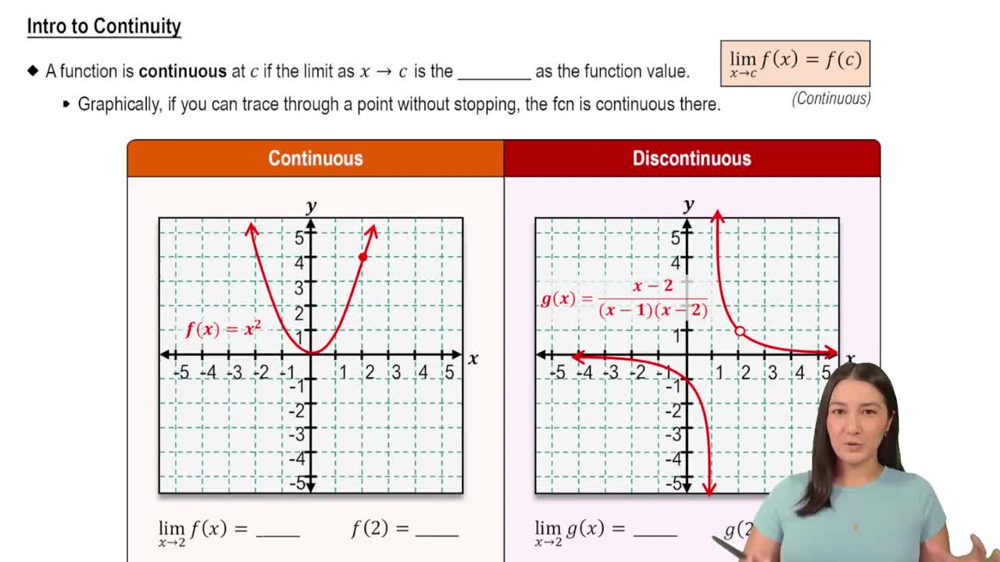
Step 2: Recall the definition of continuity. A function is continuous at a point if it is defined at that point, the limit exists at that point, and the limit equals the function value.
Step 3: Identify the domain of k(x). Since k(x) = x-1/6 involves a root in the denominator, it is undefined for x = 0. Therefore, the function is not continuous at x = 0.
Step 4: Consider the behavior of the function for x > 0 and x < 0. For x > 0, the function is defined and continuous because the root is real and positive. For x < 0, the function is also defined and continuous because the root is real and negative.
Step 5: Conclude the intervals of continuity. The function k(x) = x-1/6 is continuous on the intervals (-∞, 0) and (0, ∞), excluding x = 0 where the function is undefined.
Verified video answer for a similar problem:
This video solution was recommended by our tutors as helpful for the problem above
Video duration:
2m
Play a video:
0 Comments
Key Concepts
Here are the essential concepts you must grasp in order to answer the question correctly.
Limits
Limits are fundamental in calculus, representing the value that a function approaches as the input approaches a certain point. Understanding limits is crucial for analyzing the behavior of functions, especially at points where they may not be explicitly defined. For example, the limit of k(x) as x approaches 0 helps determine the continuity of the function at that point.
A function is continuous at a point if the limit of the function as it approaches that point equals the function's value at that point. For a function to be continuous over an interval, it must be continuous at every point within that interval. This concept is essential for determining where the function k(x) = x⁻¹/⁶ is continuous, particularly around points where the function may be undefined.
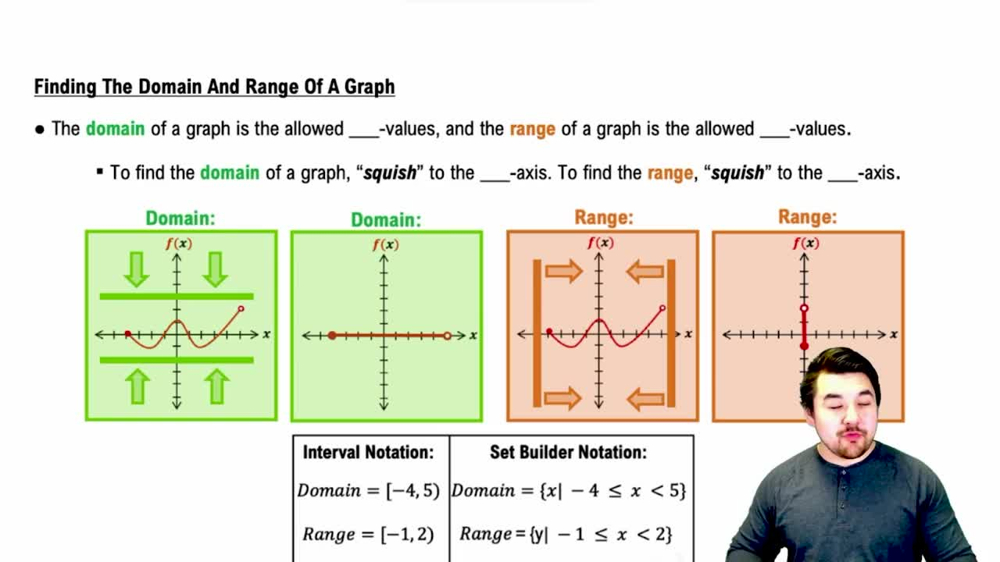
The domain of a function is the set of all possible input values (x-values) for which the function is defined. For k(x) = x⁻¹/⁶, the function is undefined when x = 0, as it would involve division by zero. Identifying the domain is critical for determining the intervals of continuity, as the function can only be continuous where it is defined.

 2:48 minutes
 Verified step by step guidance
 05:50
05:50