
Explain why the graph of the solution to the initial value problem y'(t) = t²/(1 - t), y(-1) = ln 2 cannot cross the line t = 1.
Table of contents
- 0. Functions7h 54m
- Introduction to Functions16m
- Piecewise Functions10m
- Properties of Functions9m
- Common Functions1h 8m
- Transformations5m
- Combining Functions27m
- Exponent rules32m
- Exponential Functions28m
- Logarithmic Functions24m
- Properties of Logarithms36m
- Exponential & Logarithmic Equations35m
- Introduction to Trigonometric Functions38m
- Graphs of Trigonometric Functions44m
- Trigonometric Identities47m
- Inverse Trigonometric Functions48m
- 1. Limits and Continuity2h 2m
- 2. Intro to Derivatives1h 33m
- 3. Techniques of Differentiation3h 18m
- 4. Applications of Derivatives2h 38m
- 5. Graphical Applications of Derivatives6h 2m
- 6. Derivatives of Inverse, Exponential, & Logarithmic Functions2h 37m
- 7. Antiderivatives & Indefinite Integrals1h 26m
- 8. Definite Integrals4h 44m
- 9. Graphical Applications of Integrals2h 27m
- 10. Physics Applications of Integrals 3h 16m
- 11. Integrals of Inverse, Exponential, & Logarithmic Functions2h 34m
- 12. Techniques of Integration7h 41m
- 13. Intro to Differential Equations2h 55m
- 14. Sequences & Series5h 36m
- 15. Power Series2h 19m
- 16. Parametric Equations & Polar Coordinates7h 58m
13. Intro to Differential Equations
Basics of Differential Equations
Problem 9.1.53a
Textbook Question
52-56. In this section, several models are presented and the solution of the associated differential equation is given. Later in the chapter, we present methods for solving these differential equations.
where P(t) is the population, for t ≥ 0, and r > 0 and K > 0 are given constants.
a. Verify by substitution that the general solution of the equation is P(t) = K/(1 + Ce⁻ʳᵗ), where C is an arbitrary constant.
Verified step by step guidance1
Start with the given differential equation, which is typically the logistic growth model: \[\frac{dP}{dt} = rP\left(1 - \frac{P}{K}\right),\] where \(P(t)\) is the population at time \(t\), \(r > 0\) is the growth rate, and \(K > 0\) is the carrying capacity.
Write down the proposed general solution: \[P(t) = \frac{K}{1 + Ce^{-rt}},\] where \(C\) is an arbitrary constant.
Compute the derivative of \(P(t)\) with respect to \(t\). Use the quotient rule or rewrite \(P(t)\) as \(K(1 + Ce^{-rt})^{-1}\) and apply the chain rule to find \[\frac{dP}{dt}.\]
Substitute \(P(t)\) and \(\frac{dP}{dt}\) back into the original differential equation \[\frac{dP}{dt} = rP\left(1 - \frac{P}{K}\right)\] and simplify both sides to check if they are equal.
If both sides are equal after simplification, this verifies that the proposed \(P(t)\) satisfies the differential equation, confirming it is indeed a general solution.
Verified video answer for a similar problem:This video solution was recommended by our tutors as helpful for the problem above
Video duration:
3mPlay a video:
Was this helpful?
Key Concepts
Here are the essential concepts you must grasp in order to answer the question correctly.
Logistic Differential Equation
The logistic differential equation models population growth with a carrying capacity, expressed as dP/dt = rP(1 - P/K). Here, P(t) is the population at time t, r is the growth rate, and K is the maximum sustainable population. Understanding this equation is essential to analyze how populations grow and stabilize over time.
Recommended video:
Classifying Differential Equations
Verification by Substitution
Verification by substitution involves plugging a proposed solution into the original differential equation to check if it satisfies the equation. This method confirms the correctness of the solution without solving the equation from scratch, ensuring that the given function is indeed a solution.
Recommended video:
Substitution With an Extra Variable
General Solution and Arbitrary Constants
The general solution of a differential equation includes arbitrary constants representing a family of solutions. In this case, the constant C adjusts the initial condition of the population. Recognizing the role of arbitrary constants helps in understanding how different initial populations affect the solution.
Recommended video:
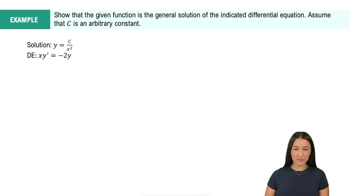
Verifying Solutions of Differential Equations Example 4
Watch next
Master Classifying Differential Equations with a bite sized video explanation from Patrick
Start learningRelated Videos
Related Practice
Textbook Question
9
views
