

Define h(2) in a way that extends h(t) = (t² + 3t − 10)/(t − 2) to be continuous at t = 2.
Verified step by step guidance
1
First, identify the function h(t) = (t² + 3t − 10)/(t − 2). Notice that the denominator becomes zero when t = 2, which makes the function undefined at this point.
To extend h(t) to be continuous at t = 2, we need to find the limit of h(t) as t approaches 2. This involves simplifying the expression to remove the discontinuity.
Factor the numerator t² + 3t − 10. Look for two numbers that multiply to -10 and add to 3. These numbers are 5 and -2, so the factorization is (t + 5)(t - 2).
Substitute the factorized form into the function: h(t) = ((t + 5)(t - 2))/(t - 2). Notice that the (t - 2) terms cancel out, simplifying the function to h(t) = t + 5 for t ≠ 2.
Now, find the limit of h(t) as t approaches 2 using the simplified function: lim(t→2) (t + 5). This limit will give the value of h(2) that makes the function continuous at t = 2.
Verified video answer for a similar problem:
This video solution was recommended by our tutors as helpful for the problem above
Video duration:
2m
Play a video:
Was this helpful?
Key Concepts
Here are the essential concepts you must grasp in order to answer the question correctly.
Limits
Limits are fundamental in calculus, representing the value that a function approaches as the input approaches a certain point. To define h(2) for continuity, we need to evaluate the limit of h(t) as t approaches 2. If this limit exists, it can be used to assign a value to h(2) that makes the function continuous at that point.
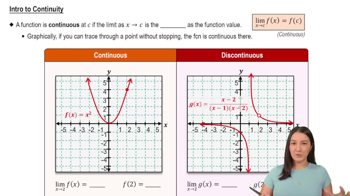
A function is continuous at a point if the limit of the function as it approaches that point equals the function's value at that point. For h(t) to be continuous at t = 2, we must ensure that h(2) is defined and equals the limit of h(t) as t approaches 2. This ensures there are no breaks or jumps in the function at that point.
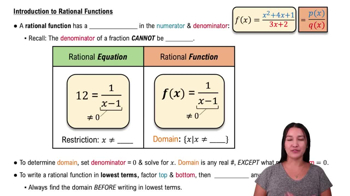
Rational functions are ratios of polynomials, and they can have points of discontinuity where the denominator equals zero. In this case, h(t) has a denominator of (t - 2), which becomes zero at t = 2, indicating a potential discontinuity. To extend h(t) to be continuous at t = 2, we need to simplify the function and find a suitable value for h(2) that resolves this discontinuity.