Find the limits in Exercises 31–40. Are the functions continuous at the point being approached? lim x → 0 sin ((π + tan x)/(tan x – 2 sec x))
Verified step by step guidance
1
Step 1: Understand the problem. We need to find the limit of the function as x approaches 0: lim x → 0 sin((π + tan x)/(tan x - 2 sec x)). Additionally, we need to determine if the function is continuous at x = 0.
Step 2: Simplify the expression inside the sine function. Start by examining the denominator tan x - 2 sec x. Recall that sec x = 1/cos x, so rewrite the expression as tan x - 2/cos x.
Step 3: Evaluate the behavior of tan x and sec x as x approaches 0. Note that tan x approaches 0 and sec x approaches 1 as x approaches 0. Substitute these values into the expression to see if it simplifies.
Step 4: Substitute the simplified expression into the sine function. If the denominator approaches a non-zero value, the limit can be evaluated directly. If the denominator approaches zero, consider using L'Hôpital's Rule, which applies to indeterminate forms like 0/0.
Step 5: Determine continuity at x = 0. A function is continuous at a point if the limit exists and equals the function's value at that point. Check if the limit found matches the value of the function at x = 0.
Verified video answer for a similar problem:
This video solution was recommended by our tutors as helpful for the problem above
Video duration:
2m
Play a video:
Was this helpful?
Key Concepts
Here are the essential concepts you must grasp in order to answer the question correctly.
Limits
Limits are fundamental in calculus, representing the value that a function approaches as the input approaches a certain point. In this case, we are interested in the limit of the function as x approaches 0. Understanding how to evaluate limits, especially when dealing with indeterminate forms, is crucial for analyzing the behavior of functions near specific points.
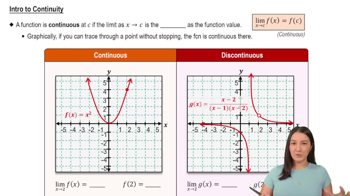
A function is continuous at a point if the limit of the function as it approaches that point equals the function's value at that point. For the given limit, we need to determine if the function remains defined and behaves predictably as x approaches 0. Continuity is essential for ensuring that there are no jumps, breaks, or holes in the function at the point of interest.
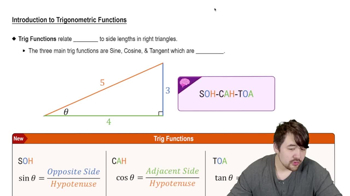
Trigonometric functions, such as sine and tangent, are periodic functions that can exhibit unique behaviors near certain points. In this limit problem, the presence of sine and tangent functions requires an understanding of their properties, especially how they behave as their arguments approach specific values. Recognizing these behaviors is key to simplifying the limit expression effectively.