Ch. 8 - Techniques of Integration
Hass - Thomas' Calculus 15th Edition
Hass15th EditionThomas' CalculusISBN: 9780137616077Not the one you use?Change textbook
Chapter 8, Problem 8.8.90c

90. Consider the infinite region in the first quadrant bounded by the graphs of
y = 1 / √x, y = 0, x = 0, and x = 1.
b. Find the volume of the solid formed by revolving the region (ii) about the y-axis.

Verified step by step guidance
1
First, identify the region bounded by the curves: \( y = \frac{1}{\sqrt{x}} \), \( y = 0 \), \( x = 0 \), and \( x = 1 \). This region lies in the first quadrant between \( x = 0 \) and \( x = 1 \), above the x-axis and below the curve \( y = \frac{1}{\sqrt{x}} \).
Since the solid is formed by revolving this region about the y-axis, we will use the method of cylindrical shells. The formula for the volume using cylindrical shells when revolving around the y-axis is: \(\n\[\n\)\[ V = 2\pi \int_{a}^{b} (\text{radius})(\text{height}) \, dx \]\(\n\]\nwhere\) the radius is the distance from the y-axis (which is \( x \)) and the height is the function value \( y = \frac{1}{\sqrt{x}} \).
Set up the integral with the limits of integration from \( x = 0 \) to \( x = 1 \): \(\n\[\n\)\[ V = 2\pi \int_{0}^{1} x \cdot \frac{1}{\sqrt{x}} \, dx \]\(\n\]\nSimplify\) the integrand before integrating.
Simplify the integrand \( x \cdot \frac{1}{\sqrt{x}} = x \cdot x^{-1/2} = x^{1 - \frac{1}{2}} = x^{\frac{1}{2}} \). So the integral becomes \(\n\)\(\n\)\[ V = 2\pi \int_{0}^{1} x^{\frac{1}{2}} \, dx \]
Evaluate the integral \( \int_{0}^{1} x^{\frac{1}{2}} \, dx \) using the power rule for integration: \(\n\[\n\)\[ \int x^{n} \, dx = \frac{x^{n+1}}{n+1} + C \]\(\n\]\nApply\) the limits from 0 to 1 and multiply by \( 2\pi \) to express the volume.

Verified video answer for a similar problem:

This video solution was recommended by our tutors as helpful for the problem above.
Video duration:
9m
Was this helpful?

Key Concepts

Here are the essential concepts you must grasp in order to answer the question correctly.

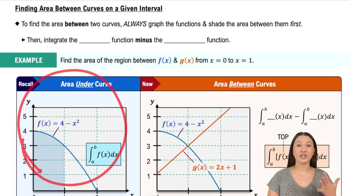
Setting up the region bounded by curves

Understanding the region involves identifying the area enclosed by the given curves y = 1/√x, y = 0, x = 0, and x = 1 in the first quadrant. This means recognizing the limits of integration and the shape formed, which is essential before applying volume formulas.
Recommended video:
05:23
Finding Area Between Curves on a Given Interval

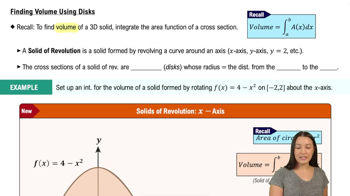
Method of cylindrical shells for volume

When revolving a region around the y-axis, the cylindrical shells method is often used. It involves integrating the volume of thin cylindrical shells with radius equal to the x-value, height given by the function, and thickness dx, allowing calculation of the solid's volume.
Recommended video:
04:48
Finding Volume Using Disks

Integration with respect to x

Since the region is bounded between x = 0 and x = 1, and the function is given as y in terms of x, the volume integral is set up with respect to x. Proper integration techniques must be applied to evaluate the integral and find the exact volume.
Recommended video:
03:39
Integrals of Natural Exponential Functions (e^x)
Related Practice
Textbook Question

Finding area

Find the area of the region enclosed by the curve y = x sin(x) and the x-axis (see the accompanying figure) for:

c. 2π ≤ x ≤ 3π.

44
views

Textbook Question

Using different substitutions

Show that the integral

∫((x² - 1)(x + 1))^(-2/3) dx

can be evaluated with any of the following substitutions.

c. u = arctan x

What is the value of the integral?

25
views
Textbook Question

89. Consider the infinite region in the first quadrant bounded by the graphs of

y = 1 / x², y = 0, and x = 1.

b. Find the volume of the solid formed by revolving the region (ii) about the y-axis.

19
views
Textbook Question

The instructions for the integrals in Exercises 1–10 have three parts, one for the Midpoint Rule, one for the Trapezoidal Rule, and one for Simpson’s Rule.

II. Using the Trapezoidal Rule

a. Estimate the integral with n = 4 steps and find an upper bound for |ET|.

∫ from 0 to π of sin(t) dth

16
views
Textbook Question

The instructions for the integrals in Exercises 1–10 have three parts, one for the Midpoint Rule, one for the Trapezoidal Rule, and one for Simpson’s Rule.

II. Using the Trapezoidal Rule

a. Estimate the integral with n = 4 steps and find an upper bound for |ET|.

∫ from 1 to 2 of 1 / s² ds

16
views
Textbook Question

In Exercises 11–22, estimate the minimum number of subintervals needed to approximate the integrals with an error of magnitude less than 10^-4 by (b) Simpson’s Rule. (The integrals in Exercises 11–18 are the integrals from Exercises 1–8.)

∫ from -1 to 1 of (x² + 1) dx

29
views