Recognize that as \(x\) approaches 4, the numerator \(x^2 - 16\) approaches \$4^2 - 16 = 0\(, and the denominator \)\ln(x - 3)\( approaches \)\ln(1) = 0\(, so this is an indeterminate form \)\frac{0}{0}$ suitable for applying Taylor series expansions.
Expand the numerator \(x^2 - 16\) around \(x = 4\) using the Taylor series (or simply use the linear approximation): \(x^2 - 16 = (4)^2 - 16 + 2 \cdot 4 (x - 4) + \cdots = 0 + 8(x - 4) + \cdots\).
Expand the denominator \(\ln(x - 3)\) around \(x = 4\). Since \(x - 3\) approaches 1, use the expansion of \(\ln(1 + h)\) where \(h = x - 4\): \(\ln(x - 3) = \ln(1 + (x - 4)) = (x - 4) - \frac{(x - 4)^2}{2} + \cdots\).
Substitute these expansions back into the limit expression and simplify by canceling common factors, then evaluate the limit by taking \(x \to 4\) (or equivalently \(h \to 0\)).
Verified video answer for a similar problem:
This video solution was recommended by our tutors as helpful for the problem above
Video duration:
3m
Play a video:
Was this helpful?
Key Concepts
Here are the essential concepts you must grasp in order to answer the question correctly.
Limits and Limit Evaluation
Limits describe the behavior of a function as the input approaches a particular value. Evaluating limits helps determine the function's value near points where direct substitution may be undefined or indeterminate, such as 0/0 or ∞/∞ forms.
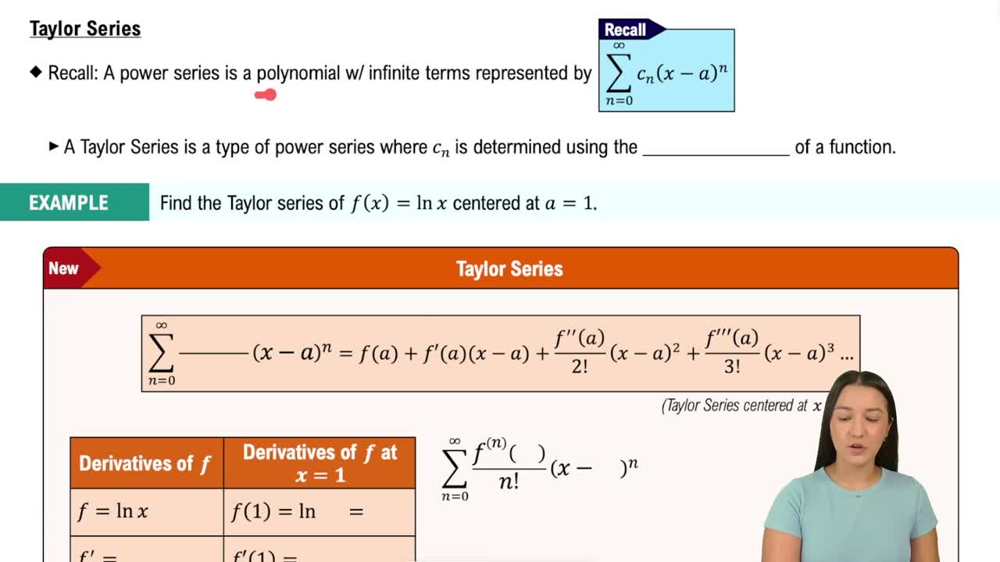
A Taylor series represents a function as an infinite sum of terms calculated from its derivatives at a single point. It approximates functions near that point, allowing simplification of complex expressions to evaluate limits or analyze behavior.
When direct substitution in limits results in indeterminate forms like 0/0, expanding numerator and denominator into Taylor series helps identify leading terms. This approach simplifies the limit evaluation by canceling common factors and revealing the limit's value.