Limits Evaluate the following limits using Taylor series. lim ₓ→∞ x sin(1/x)
Verified step by step guidance
1
Recognize that the limit involves the expression \(x \sin\left(\frac{1}{x}\right)\) as \(x\) approaches infinity, which suggests using the Taylor series expansion of \(\sin z\) around \(z=0\) where \(z = \frac{1}{x}\).
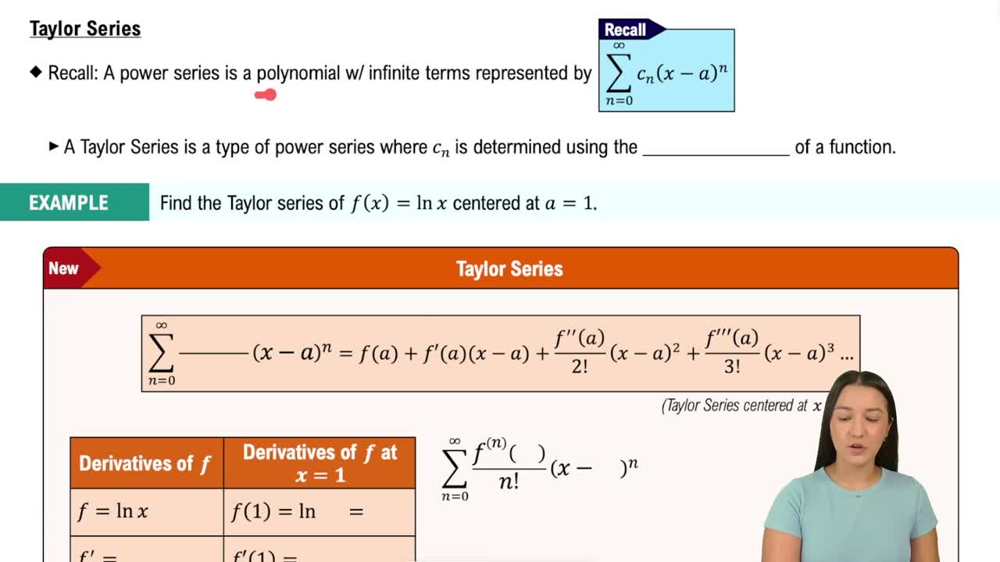
Recall the Taylor series expansion for \(\sin z\) around \(z=0\):
\(\sin z = z - \frac{z^3}{3!} + \frac{z^5}{5!} - \cdots\)
Substitute \(z = \frac{1}{x}\) into the series:
\(\sin\left(\frac{1}{x}\right) = \frac{1}{x} - \frac{1}{6x^3} + \frac{1}{120x^5} - \cdots\)
Multiply the entire series by \(x\):
\(x \sin\left(\frac{1}{x}\right) = x \left( \frac{1}{x} - \frac{1}{6x^3} + \frac{1}{120x^5} - \cdots \right) = 1 - \frac{1}{6x^2} + \frac{1}{120x^4} - \cdots\)
Evaluate the limit as \(x \to \infty\) by observing that all terms with \(x\) in the denominator approach zero, so the limit is the constant term remaining in the expression.
Verified video answer for a similar problem:
This video solution was recommended by our tutors as helpful for the problem above
Video duration:
3m
Play a video:
Was this helpful?
Key Concepts
Here are the essential concepts you must grasp in order to answer the question correctly.
Limits at Infinity
Limits at infinity describe the behavior of a function as the input grows without bound. Understanding how functions behave as x approaches infinity helps determine if the function approaches a finite value, infinity, or does not exist.
A Taylor series represents a function as an infinite sum of terms calculated from its derivatives at a single point. It approximates functions near that point, allowing complex expressions like sin(1/x) to be expanded into simpler polynomial terms for limit evaluation.
Asymptotic behavior studies how functions behave near specific points or at infinity. By analyzing dominant terms in expansions, one can simplify expressions like x sin(1/x) to find limits, focusing on leading terms that dictate the function's growth or decay.