a. Verify that ƒ'(x) = 3(x - 1) (x + 3) and ƒ"(x) = 6 (x + 1).
Verified step by step guidance
1
Step 1: Begin by expanding the function ƒ(x) = (x - 3)(x + 3)^2. Use the distributive property to expand (x + 3)^2, which results in (x + 3)(x + 3) = x^2 + 6x + 9.
Step 2: Multiply the expanded form of (x + 3)^2 by (x - 3). This involves distributing (x - 3) across each term in the polynomial x^2 + 6x + 9, resulting in a new polynomial expression.
Step 3: Differentiate the expanded polynomial expression to find ƒ'(x). Apply the power rule, which states that the derivative of x^n is n*x^(n-1), to each term in the polynomial.
Step 4: Simplify the expression obtained from differentiation to verify that ƒ'(x) = 3(x - 1)(x + 3). This involves factoring the derivative to match the given expression.
Step 5: Differentiate ƒ'(x) to find ƒ"(x). Again, use the power rule and simplify the resulting expression to verify that ƒ"(x) = 6(x + 1).
Verified video answer for a similar problem:
This video solution was recommended by our tutors as helpful for the problem above
Video duration:
4m
Play a video:
0 Comments
Key Concepts
Here are the essential concepts you must grasp in order to answer the question correctly.
Product Rule
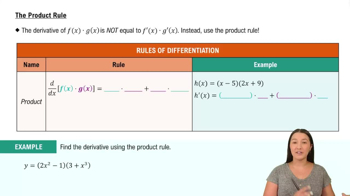
The Product Rule is a fundamental principle in calculus used to differentiate products of two or more functions. It states that if you have two functions, u(x) and v(x), the derivative of their product is given by u'v + uv'. This rule is essential for finding the derivative of ƒ(x) = (x - 3)(x + 3)², as it involves multiplying two functions.
The Chain Rule is another critical differentiation technique that allows us to differentiate composite functions. If a function is defined as g(h(x)), the Chain Rule states that the derivative is g'(h(x)) * h'(x). This concept is particularly relevant when differentiating the squared term (x + 3)² in the function ƒ(x), as it requires applying the Chain Rule to find its derivative.
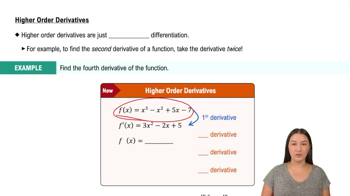
Higher-order derivatives refer to the derivatives of a function taken multiple times. The first derivative, ƒ'(x), gives the rate of change of the function, while the second derivative, ƒ''(x), provides information about the curvature or concavity of the function. In this question, verifying both ƒ'(x) and ƒ''(x) is crucial for understanding the behavior of the function and confirming the correctness of the derivatives.


 4:37 minutes
 Verified step by step guidance
 05:18
05:18