

Derivatives of sin^n x Calculate the following derivatives using the Product Rule. c. d/dx (sin⁴ x)
Verified step by step guidance
1
First, recognize that the function sin⁴(x) can be rewritten as (sin(x))⁴. This helps in applying the chain rule effectively.
Apply the chain rule: If you have a function u(x) raised to a power n, the derivative is n * u(x)^(n-1) * u'(x). Here, u(x) = sin(x) and n = 4.
Calculate the derivative of u(x) = sin(x), which is u'(x) = cos(x).
Substitute u(x) = sin(x) and u'(x) = cos(x) into the chain rule formula: 4 * (sin(x))³ * cos(x).
Simplify the expression to get the derivative: 4 * sin³(x) * cos(x). This is the derivative of sin⁴(x) using the chain rule.
Verified video answer for a similar problem:
This video solution was recommended by our tutors as helpful for the problem above
Video duration:
4m
Play a video:
Was this helpful?
Key Concepts
Here are the essential concepts you must grasp in order to answer the question correctly.
Product Rule
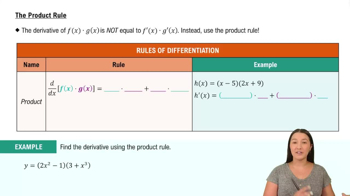
The Product Rule is a fundamental differentiation technique used when finding the derivative of a product of two functions. It states that if you have two functions, u(x) and v(x), the derivative of their product is given by d/dx [u(x)v(x)] = u'(x)v(x) + u(x)v'(x). This rule is essential for calculating derivatives where functions are multiplied together, such as in the case of sin^n x.
The Chain Rule is another critical differentiation rule used when dealing with composite functions. It states that if a function y is composed of another function u, such that y = f(u) and u = g(x), then the derivative is given by dy/dx = dy/du * du/dx. In the context of sin^n x, the Chain Rule is necessary to differentiate the inner function (sin x) raised to a power.
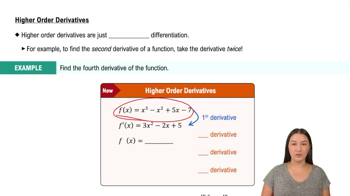
Higher order derivatives refer to the derivatives of a function taken multiple times. For example, the second derivative is the derivative of the first derivative. In the context of sin^n x, understanding higher order derivatives can be important for analyzing the behavior of the function, such as concavity and points of inflection, especially when applying the Product Rule and Chain Rule in more complex scenarios.