
Ch.12 - Parametric and Polar Curves
Briggs - Calculus: Early Transcendentals 3rd Edition
Briggs3rd EditionCalculus: Early TranscendentalsISBN: 9780136847243Not the one you use?Change textbook
Chapter 12, Problem 12.1.69a

67–72. Derivatives Consider the following parametric curves.
a. Determine dy/dx in terms of t and evaluate it at the given value of t.


x = cos t, y = 8 sin t; t = π/2

Verified step by step guidance
1
Recall that for parametric curves defined by \(x = x(t)\) and \(y = y(t)\), the derivative \(\frac{dy}{dx}\) can be found using the chain rule as \(\frac{dy}{dx} = \frac{\frac{dy}{dt}}{\frac{dx}{dt}}\).
Given the parametric equations \(x = \cos t\) and \(y = 8 \sin t\), compute the derivatives with respect to \(t\): \(\frac{dx}{dt} = -\sin t\) and \(\frac{dy}{dt} = 8 \cos t\).
Substitute these derivatives into the formula for \(\frac{dy}{dx}\) to get \(\frac{dy}{dx} = \frac{8 \cos t}{-\sin t} = -8 \frac{\cos t}{\sin t}\).
Evaluate \(\frac{dy}{dx}\) at the given value \(t = \frac{\pi}{2}\) by substituting \(t\) into the expression \(-8 \frac{\cos t}{\sin t}\).
Simplify the expression after substitution to find the slope of the curve at \(t = \frac{\pi}{2}\).

Verified video answer for a similar problem:

This video solution was recommended by our tutors as helpful for the problem above.
Video duration:
2m
Was this helpful?

Key Concepts

Here are the essential concepts you must grasp in order to answer the question correctly.

Parametric Equations

Parametric equations express the coordinates of points on a curve as functions of a parameter, often denoted as t. Instead of y as a function of x, both x and y depend on t, allowing the description of more complex curves. Understanding how to work with these equations is essential for analyzing motion and curves in calculus.
Recommended video:
Guided course
08:02
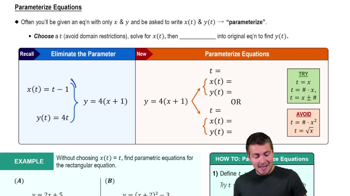
Parameterizing Equations

Derivative of Parametric Curves (dy/dx)

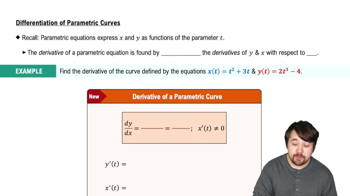
For parametric curves, the derivative dy/dx is found by dividing the derivative of y with respect to t by the derivative of x with respect to t, i.e., (dy/dt) / (dx/dt). This method allows us to find the slope of the tangent line to the curve at a specific parameter value, even when y is not explicitly given as a function of x.
Recommended video:
06:49
Differentiation of Parametric Curves

Evaluating Derivatives at Specific Parameter Values

After finding the general expression for dy/dx in terms of t, evaluating it at a specific value of t gives the slope of the tangent line at that point on the curve. This step involves substituting the given t-value into the derivative expressions and simplifying to find the numerical slope.
Recommended video:
5:10
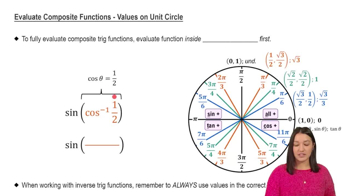
Evaluate Composite Functions - Values on Unit Circle
Related Practice
Textbook Question

11–14. Working with parametric equations Consider the following parametric equations.

a. Make a brief table of values of t, x, and y.

b. Plot the (x, y) pairs in the table and the complete parametric curve, indicating the positive orientation (the direction of increasing t).


x=2 t,y=3t−4;−10≤d≤10 

52
views
Textbook Question

Reflection property of parabolas: Consider the parabola y = x²/(4p) with its focus at F(0, p). The goal is to show that the angle of incidence (α) equals the angle of reflection (β).

a. Let P(x₀, y₀) be a point on the parabola. Show that the slope of the tangent line at P is tan θ = x₀/(2p).

296
views
Textbook Question

Cartesian conversion Write the equation x=y ² in polar coordinates and state values of θ that produce the entire graph of the parabola.

83
views
Textbook Question

14–18. Parametric descriptions Write parametric equations for the following curves. Solutions are not unique.

The segment of the curve x=y ³ +y+1 that starts at (1, 0) and ends at (11, 2).

63
views
Textbook Question

Eliminate the parameter in the parametric equations x=1+sin t, y=3+2 sin t, for 0≤t≤π/2, and describe the curve, indicating its positive orientation. How does this curve differ from the curve x=1+sin t, y=3+2 sin t, for π/2≤t≤π?

64
views
Textbook Question

(Use of Tech) Finger curves: r = f(θ) = cos(aᶿ) - 1.5, where a = (1 + 12π)^(1/(2π)) ≈ 1.78933

a. Show that f(0) = f(2π) and find the point on the curve that corresponds to θ = 0 and θ = 2π.

54
views