Ch.12 - Parametric and Polar Curves
Briggs - Calculus: Early Transcendentals 3rd Edition
Briggs3rd EditionCalculus: Early TranscendentalsISBN: 9780136847243Not the one you use?Change textbook
Chapter 12, Problem 12.1.52

37–52. Curves to parametric equations Find parametric equations for the following curves. Include an interval for the parameter values. Answers are not unique.


The lower half of the circle centered at (−2, 2) with radius 6, oriented in the counterclockwise direction

Verified step by step guidance
1
Recall the general parametric equations for a circle centered at \((h, k)\) with radius \(r\): \[x = h + r \cos(t), \quad y = k + r \sin(t)\] where \(t\) is the parameter, usually representing the angle in radians.
Identify the given values from the problem: the center is \((-2, 2)\) and the radius is \(6\). Substitute these into the general form: \[x = -2 + 6 \cos(t), \quad y = 2 + 6 \sin(t)\]
Since the problem asks for the lower half of the circle, determine the range of \(t\) that corresponds to the lower semicircle. The lower half means \(y \leq 2\), so \(\sin(t) \leq 0\). This occurs when \(t\) is between \(\pi\) and \(2\pi\).
Confirm the orientation is counterclockwise. The parameter \(t\) increasing from \(\pi\) to \(2\pi\) moves the point along the circle in the counterclockwise direction on the lower half.
Write the final parametric equations with the parameter interval: \[x = -2 + 6 \cos(t), \quad y = 2 + 6 \sin(t), \quad \pi \leq t \leq 2\pi\]

Verified video answer for a similar problem:

This video solution was recommended by our tutors as helpful for the problem above.
Video duration:
2m
Was this helpful?

Key Concepts

Here are the essential concepts you must grasp in order to answer the question correctly.

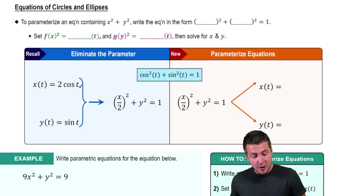
Parametric Equations of a Circle

A circle centered at (h, k) with radius r can be represented parametrically as x = h + r cos(t) and y = k + r sin(t), where t is the parameter. This form allows describing the position of points on the circle as t varies, typically over an interval of length 2π.
Recommended video:
Guided course
06:03
Parameterizing Equations of Circles & Ellipses

Parameter Interval and Orientation

The parameter interval defines which portion of the curve is traced and in what direction. For counterclockwise orientation, t usually increases from 0 to 2π. To represent only the lower half of the circle, t is restricted to the interval where y-values correspond to the lower semicircle.
Recommended video:
Guided course
05:59
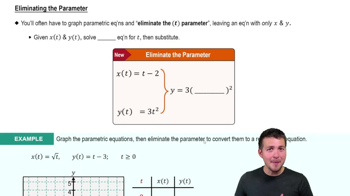
Eliminating the Parameter

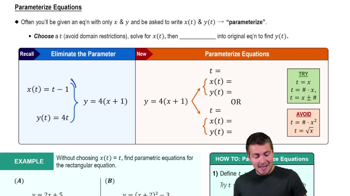
Adjusting Parametric Equations for Specific Curve Segments

To describe a specific segment of a curve, such as the lower half of a circle, the parameter range is limited accordingly. Understanding how the sine and cosine functions behave over intervals helps select the correct parameter bounds to capture the desired portion of the curve.
Recommended video:
Guided course
08:02
Parameterizing Equations