
Let with . Compute the first three approximations given by Euler’s Method with a step size of .
Table of contents
- 0. Functions7h 54m
- Introduction to Functions16m
- Piecewise Functions10m
- Properties of Functions9m
- Common Functions1h 8m
- Transformations5m
- Combining Functions27m
- Exponent rules32m
- Exponential Functions28m
- Logarithmic Functions24m
- Properties of Logarithms36m
- Exponential & Logarithmic Equations35m
- Introduction to Trigonometric Functions38m
- Graphs of Trigonometric Functions44m
- Trigonometric Identities47m
- Inverse Trigonometric Functions48m
- 1. Limits and Continuity2h 2m
- 2. Intro to Derivatives1h 33m
- 3. Techniques of Differentiation3h 18m
- 4. Applications of Derivatives2h 38m
- 5. Graphical Applications of Derivatives6h 2m
- 6. Derivatives of Inverse, Exponential, & Logarithmic Functions2h 37m
- 7. Antiderivatives & Indefinite Integrals1h 26m
- 8. Definite Integrals4h 44m
- 9. Graphical Applications of Integrals2h 27m
- 10. Physics Applications of Integrals 3h 16m
- 11. Integrals of Inverse, Exponential, & Logarithmic Functions2h 34m
- 12. Techniques of Integration7h 41m
- 13. Intro to Differential Equations2h 55m
- 14. Sequences & Series5h 36m
- 15. Power Series2h 19m
- 16. Parametric Equations & Polar Coordinates7h 58m
13. Intro to Differential Equations
Euler's Method
Problem 9.2.30d
Textbook Question
29–32. {Use of Tech} Errors in Euler’s method Consider the following initial value problems.
d. In general, how does halving the time step affect the error at t=0.2 and t=0.4?
y′(t) = y/2, y(0) = 2; y(t) = 2eᵗᐟ²
Verified step by step guidance1
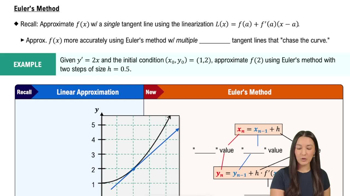
Recall that Euler's method approximates the solution to the differential equation by using the formula \(y_{n+1} = y_n + h f(t_n, y_n)\), where \(h\) is the time step size.
Understand that the local truncation error of Euler's method at each step is proportional to \(h^2\), and the global error (error accumulated over multiple steps) is proportional to \(h\).
Since the global error is roughly proportional to the step size \(h\), halving the time step \(h\) will approximately halve the error at any fixed time \(t\), such as \(t=0.2\) and \(t=0.4\).
To see this concretely, consider the number of steps needed to reach \(t=0.2\) and \(t=0.4\) with step size \(h\) and with step size \(h/2\). The smaller step size means more steps but smaller error per step, resulting in an overall smaller total error.
Therefore, halving the time step reduces the global error roughly by a factor of 2 at the specified times, improving the accuracy of Euler's method for this problem.
Verified video answer for a similar problem:This video solution was recommended by our tutors as helpful for the problem above
Video duration:
1mPlay a video:
Was this helpful?
Key Concepts
Here are the essential concepts you must grasp in order to answer the question correctly.
Euler's Method
Euler's method is a numerical technique to approximate solutions of initial value problems for ordinary differential equations. It uses a stepwise approach, estimating the next value by moving along the slope (derivative) at the current point multiplied by a small time step. The accuracy depends on the step size chosen.
Recommended video:
Euler's Method
Local and Global Truncation Error
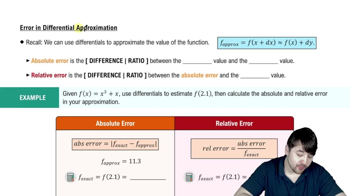
Local truncation error is the error made in a single step of Euler's method, while global truncation error accumulates over multiple steps. For Euler's method, the local error is proportional to the square of the step size, and the global error is proportional to the step size, meaning smaller steps reduce overall error.
Recommended video:
Determining Error and Relative Error
Effect of Step Size on Error
Halving the time step in Euler's method generally reduces the global error approximately by half, improving accuracy. This is because the global error is linearly dependent on the step size, so smaller steps lead to more precise approximations at given points like t=0.2 and t=0.4.
Recommended video:
Determining Error and Relative Error
Related Videos
Related Practice
Multiple Choice
72
views
