Given the series ∑∞ₖ₌₁ k, evaluate the first four terms of its sequence of partial sums Sₙ = ∑ⁿₖ₌₁ k.
Table of contents
- 0. Functions7h 54m
- Introduction to Functions16m
- Piecewise Functions10m
- Properties of Functions9m
- Common Functions1h 8m
- Transformations5m
- Combining Functions27m
- Exponent rules32m
- Exponential Functions28m
- Logarithmic Functions24m
- Properties of Logarithms36m
- Exponential & Logarithmic Equations35m
- Introduction to Trigonometric Functions38m
- Graphs of Trigonometric Functions44m
- Trigonometric Identities47m
- Inverse Trigonometric Functions48m
- 1. Limits and Continuity2h 2m
- 2. Intro to Derivatives1h 33m
- 3. Techniques of Differentiation3h 18m
- 4. Applications of Derivatives2h 38m
- 5. Graphical Applications of Derivatives6h 2m
- 6. Derivatives of Inverse, Exponential, & Logarithmic Functions2h 37m
- 7. Antiderivatives & Indefinite Integrals1h 26m
- 8. Definite Integrals4h 44m
- 9. Graphical Applications of Integrals2h 27m
- 10. Physics Applications of Integrals 3h 16m
- 11. Integrals of Inverse, Exponential, & Logarithmic Functions2h 34m
- 12. Techniques of Integration7h 41m
- 13. Intro to Differential Equations2h 55m
- 14. Sequences & Series5h 36m
- 15. Power Series2h 19m
- 16. Parametric Equations & Polar Coordinates7h 58m
14. Sequences & Series
Sequences
Problem 10.1.19
Textbook Question
13–20. Explicit formulas Write the first four terms of the sequence { aₙ }∞ₙ₌₁.
aₙ = 1 + sin(πn / 2)
Verified step by step guidance1
Identify the given explicit formula for the sequence: \(a_n = 1 + \sin\left(\frac{\pi n}{2}\right)\), where \(n\) is a positive integer starting from 1.
Recall that to find the first four terms of the sequence, you need to substitute \(n = 1, 2, 3, 4\) into the formula one by one.
Calculate each term by plugging in the values of \(n\):
- For \(n=1\), compute \(a_1 = 1 + \sin\left(\frac{\pi \times 1}{2}\right)\).
- For \(n=2\), compute \(a_2 = 1 + \sin\left(\frac{\pi \times 2}{2}\right)\).
- For \(n=3\), compute \(a_3 = 1 + \sin\left(\frac{\pi \times 3}{2}\right)\).
- For \(n=4\), compute \(a_4 = 1 + \sin\left(\frac{\pi \times 4}{2}\right)\).
Use your knowledge of sine values at special angles (multiples of \(\frac{\pi}{2}\)) to simplify each sine term without a calculator, for example, \(\sin\left(\frac{\pi}{2}\right)\), \(\sin(\pi)\), \(\sin\left(\frac{3\pi}{2}\right)\), and \(\sin(2\pi)\).
Write down the first four terms \(a_1, a_2, a_3, a_4\) explicitly after simplification to complete the sequence.
Verified video answer for a similar problem:This video solution was recommended by our tutors as helpful for the problem above
Video duration:
2mPlay a video:
Was this helpful?
Key Concepts
Here are the essential concepts you must grasp in order to answer the question correctly.
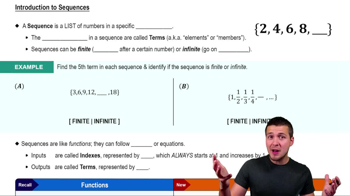
Sequences and Terms
A sequence is an ordered list of numbers defined by a specific rule or formula. Each number in the sequence is called a term, denoted as aₙ, where n indicates the position. Understanding how to find terms from the formula is essential to write out the sequence.
Recommended video:
Guided course
Introduction to Sequences
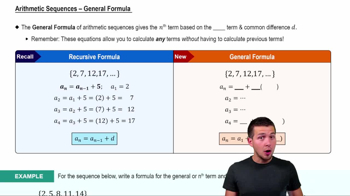
Explicit Formula for Sequences
An explicit formula directly defines the nth term of a sequence as a function of n, allowing calculation of any term without knowing previous terms. For example, aₙ = 1 + sin(πn/2) gives a direct way to find each term by substituting n.
Recommended video:
Guided course
Arithmetic Sequences - General Formula
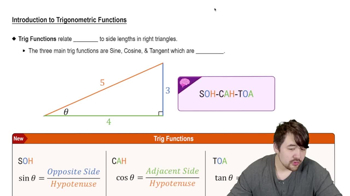
Evaluating Trigonometric Functions at Specific Angles
To find terms involving sine functions, you must evaluate sin(θ) at specific angles, often multiples of π. Knowing values like sin(0) = 0, sin(π/2) = 1, sin(π) = 0, and sin(3π/2) = -1 helps compute terms accurately.
Recommended video:
Introduction to Trigonometric Functions
Watch next
Master Introduction to Sequences with a bite sized video explanation from Patrick
Start learningRelated Videos
Related Practice
Textbook Question
14
views