Ch. 5 - Integration
Briggs - Calculus: Early Transcendentals 3rd Edition
Briggs3rd EditionCalculus: Early TranscendentalsISBN: 9780136847243Not the one you use?Change textbook
Chapter 5, Problem 5.1.47b

Sigma notation Express the following sums using sigma notation. (Answers are not unique.)
(b) 4 + 5 + 6 + 7 + 8 + 9

Verified step by step guidance
1
Step 1: Understand the problem. The goal is to express the sum 4 + 5 + 6 + 7 + 8 + 9 using sigma notation, which is a compact way to represent summation.
Step 2: Identify the pattern in the sequence. The numbers in the sum are consecutive integers starting from 4 and ending at 9.
Step 3: Define the general term of the sequence. The general term can be written as k, where k represents each integer in the sequence.
Step 4: Determine the range of the index. The sequence starts at 4 and ends at 9, so the index k will range from 4 to 9.
Step 5: Write the sum in sigma notation. The sum can be expressed as kk=4...9.

Verified video answer for a similar problem:

This video solution was recommended by our tutors as helpful for the problem above.
Video duration:
1m
Was this helpful?

Key Concepts

Here are the essential concepts you must grasp in order to answer the question correctly.

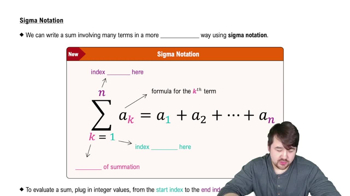
Sigma Notation

Sigma notation is a concise way to represent the sum of a sequence of numbers. It uses the Greek letter sigma (Σ) to indicate summation, followed by an expression that defines the terms to be added. The notation typically includes an index of summation, which specifies the starting and ending values for the variable that represents the terms in the sum.
Recommended video:
04:22
Sigma Notation

Index of Summation

The index of summation is a variable used in sigma notation to denote the position of each term in the sequence being summed. It usually starts at a specified lower limit and increments by one until it reaches an upper limit. For example, in the sum Σ from i=1 to n, 'i' is the index that takes on integer values from 1 to n, allowing for the systematic addition of terms.
Recommended video:
04:22
Sigma Notation

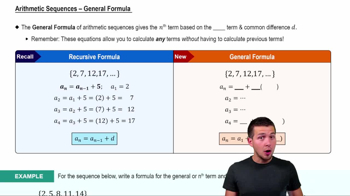
Arithmetic Sequence

An arithmetic sequence is a sequence of numbers in which the difference between consecutive terms is constant. In the case of the sum 4 + 5 + 6 + 7 + 8 + 9, the common difference is 1. Recognizing that the terms form an arithmetic sequence helps in expressing the sum using sigma notation, as it allows for a general formula to represent the terms based on their position in the sequence.
Recommended video:
Guided course
5:17
Arithmetic Sequences - General Formula
Related Practice
Textbook Question

Sigma notation Evaluate the following expressions.                                                                                                                                          

(b)    10                                                                                                                                                                               

       ∑  (2κ + 1)                                                                                                                                                                          

       κ=1                         

83
views

Textbook Question

Displacement from a table of velocities The velocities (in mi/hr) of an automobile moving along a straight highway over a two-hour period are given in the following table.

(b) Find the midpoint Riemann sum approximation to the displacement on [0,2] with n = 2 and .n = 4 .

67
views
Textbook Question

Use Table 5.6 to evaluate the following indefinite integrals.                                                                                                               


 (b) ∫ sec 5𝓍 tan 5𝓍 d𝓍

103
views
Textbook Question

{Use of Tech} Midpoint Riemann sums with a calculator Consider the following definite integrals.

(b) Evaluate each sum using a calculator with n = 20, 50, and 100. Use these values to estimate the value of the integral.


∫₁⁴ 2√𝓍 d𝓍

88
views
Textbook Question

{Use of Tech} Approximating net area The following functions are positive and negative on the given interval.


ƒ(x) = 4 - 2x on [0,4]


(b) Approximate the net area bounded by the graph of f and the x-axis on the interval using a left, right, and midpoint Riemann sum with n = 4.

48
views
Textbook Question

Mass from density A thin 10-cm rod is made of an alloy whose density varies along its length according to the function shown in the figure. Assume density is measured in units of g/cm. In Chapter 6, we show that the mass of the rod is the area under the density curve.

(b) Find the mass of the right half of the rod (5 ≤ x ≤ 10) .

46
views