Sigma notation Express the following sums using sigma notation. (Answers are not unique.) (d) 1 + 1/2 + 1/3 + 1/4
Verified step by step guidance
1
Identify the pattern in the given sequence: The terms are fractions with the numerator fixed at 1 and the denominator increasing sequentially (1, 2, 3, 4).
Recognize that the general term for this sequence can be expressed as , where represents the position of the term in the sequence.
Determine the range of the index : The sequence starts at and ends at .
Write the sum in sigma notation: , where the summation symbol indicates the sum of the terms from to .
Verify the sigma notation by expanding it: Substitute values (1, 2, 3, 4) into the general term to confirm that it matches the original sequence.
Verified video answer for a similar problem:
This video solution was recommended by our tutors as helpful for the problem above
Video duration:
2m
Play a video:
Was this helpful?
Key Concepts
Here are the essential concepts you must grasp in order to answer the question correctly.
Sigma Notation
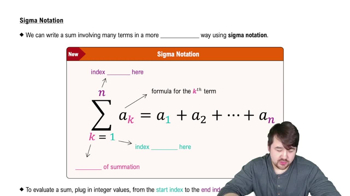
Sigma notation is a concise way to represent the sum of a sequence of terms. It uses the Greek letter sigma (Σ) to indicate summation, followed by an expression that defines the terms to be added. The notation typically includes an index of summation, which specifies the starting and ending values for the variable that represents the terms.
The index of summation is a variable used in sigma notation to denote the position of each term in the sequence being summed. It usually starts at a specified lower limit and increments by one until it reaches an upper limit. For example, in the sum Σ from i=1 to n, 'i' is the index that takes on values from 1 to n.
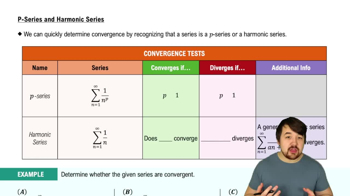
The series represented by the sum 1 + 1/2 + 1/3 + 1/4 is known as the harmonic series. Each term in this series is the reciprocal of a positive integer. Understanding the harmonic series is important because it illustrates concepts of convergence and divergence in infinite series, although in this case, we are only summing a finite number of terms.