
Sigma notation Evaluate the following expressions. (b) 10 ∑ (2κ + 1) κ=1
Verified step by step guidance
1
Step 1: Understand the problem. The given expression is a summation in sigma notation: ∑ (2κ + 1), where κ starts at 1 and goes up to 10. This means we need to calculate the sum of the expression (2κ + 1) for each integer value of κ from 1 to 10.
Step 2: Write out the terms of the summation explicitly. Substitute κ = 1, κ = 2, ..., κ = 10 into the expression (2κ + 1). This will give the terms: (2*1 + 1), (2*2 + 1), ..., (2*10 + 1).
Step 3: Simplify each term. For example, when κ = 1, the term becomes 2*1 + 1 = 3. Similarly, calculate the terms for κ = 2, κ = 3, ..., κ = 10.
Step 4: Add all the simplified terms together. Once you have the values for each term, sum them up to find the total value of the summation.
Step 5: Verify your work. Double-check each substitution and addition to ensure accuracy in your calculations.
Verified video answer for a similar problem:
This video solution was recommended by our tutors as helpful for the problem above
Video duration:
3m
Play a video:
Was this helpful?
Key Concepts
Here are the essential concepts you must grasp in order to answer the question correctly.
Sigma Notation
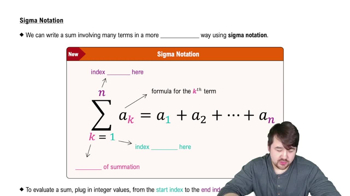
Sigma notation is a concise way to represent the sum of a sequence of terms. It uses the Greek letter sigma (Σ) to indicate summation, followed by an expression that defines the terms to be summed. The notation includes limits that specify the starting and ending indices of the summation, allowing for the calculation of sums over a defined range.
A series is the sum of the terms of a sequence. In calculus, series can be finite or infinite, and they are often analyzed for convergence or divergence. Understanding how to manipulate and evaluate series is crucial for solving problems involving sigma notation, as it allows for the simplification and calculation of complex sums.
The index of summation is the variable used to represent the position of each term in the sequence being summed. It typically starts at a specified value and increments by one until it reaches a defined upper limit. Mastery of how to correctly interpret and manipulate the index is essential for accurately evaluating expressions in sigma notation.