Explain why the magnitude of the remainder in an alternating series (with terms that are nonincreasing in magnitude) is less than or equal to the magnitude of the first neglected term.
Table of contents
- 0. Functions7h 54m
- Introduction to Functions16m
- Piecewise Functions10m
- Properties of Functions9m
- Common Functions1h 8m
- Transformations5m
- Combining Functions27m
- Exponent rules32m
- Exponential Functions28m
- Logarithmic Functions24m
- Properties of Logarithms36m
- Exponential & Logarithmic Equations35m
- Introduction to Trigonometric Functions38m
- Graphs of Trigonometric Functions44m
- Trigonometric Identities47m
- Inverse Trigonometric Functions48m
- 1. Limits and Continuity2h 2m
- 2. Intro to Derivatives1h 33m
- 3. Techniques of Differentiation3h 18m
- 4. Applications of Derivatives2h 38m
- 5. Graphical Applications of Derivatives6h 2m
- 6. Derivatives of Inverse, Exponential, & Logarithmic Functions2h 37m
- 7. Antiderivatives & Indefinite Integrals1h 26m
- 8. Definite Integrals4h 44m
- 9. Graphical Applications of Integrals2h 27m
- 10. Physics Applications of Integrals 3h 16m
- 11. Integrals of Inverse, Exponential, & Logarithmic Functions2h 34m
- 12. Techniques of Integration7h 41m
- 13. Intro to Differential Equations2h 55m
- 14. Sequences & Series5h 36m
- 15. Power Series2h 19m
- 16. Parametric Equations & Polar Coordinates7h 58m
14. Sequences & Series
Series
Problem 10.6.39
Textbook Question
39–44. {Use of Tech} Estimating infinite series Estimate the value of the following convergent series with an absolute error less than 10⁻³.
∑ (k = 1 to ∞) (−1)ᵏ / k⁵
Verified step by step guidance1
Recognize that the series given is an alternating series of the form \(\sum_{k=1}^\infty \frac{(-1)^k}{k^5}\), where the terms decrease in absolute value and approach zero as \(k\) increases, which means the series converges by the Alternating Series Test.
To estimate the sum with an absolute error less than \$10^{-3}\(, use the Alternating Series Estimation Theorem, which states that the absolute error when approximating the sum by the first \)n\( terms is less than or equal to the absolute value of the first omitted term, i.e., \)|R_n| \leq |a_{n+1}|$.
Find the smallest integer \(n\) such that the absolute value of the \((n+1)\)-th term satisfies \(\left| \frac{(-1)^{n+1}}{(n+1)^5} \right| = \frac{1}{(n+1)^5} < 10^{-3}\).
Once \(n\) is found, compute the partial sum \(S_n = \sum_{k=1}^n \frac{(-1)^k}{k^5}\) by adding the first \(n\) terms of the series.
This partial sum \(S_n\) will be an estimate of the infinite series with an absolute error less than \$10^{-3}$, as guaranteed by the Alternating Series Estimation Theorem.
Verified video answer for a similar problem:This video solution was recommended by our tutors as helpful for the problem above
Video duration:
2mPlay a video:
Was this helpful?
Key Concepts
Here are the essential concepts you must grasp in order to answer the question correctly.
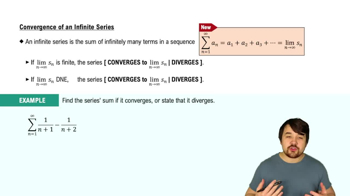
Convergence of Infinite Series
An infinite series converges if the sum of its terms approaches a finite limit as the number of terms increases. For alternating series like this one, the Alternating Series Test helps determine convergence by checking if terms decrease in absolute value and approach zero.
Recommended video:
Convergence of an Infinite Series
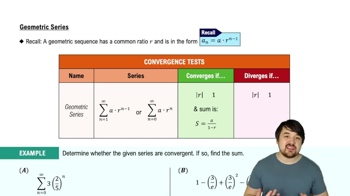
Alternating Series Estimation Theorem
This theorem states that the absolute error when approximating an alternating series by its partial sum is less than or equal to the absolute value of the first omitted term. It allows us to estimate how many terms are needed to achieve a desired error bound.
Recommended video:
Geometric Series
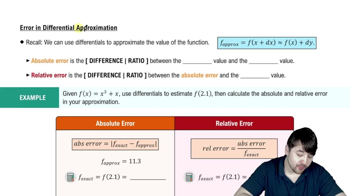
Absolute Error and Partial Sums
Absolute error measures the difference between the true sum and the partial sum approximation. By calculating partial sums and comparing the size of the next term, we can ensure the error is below a specified threshold, such as 10⁻³ in this problem.
Recommended video:
Determining Error and Relative Error
Watch next
Master Intro to Series: Partial Sums with a bite sized video explanation from Patrick
Start learningRelated Videos
Related Practice
Textbook Question
19
views