Ch.12 - Parametric and Polar Curves
Briggs - Calculus: Early Transcendentals 3rd Edition
Briggs3rd EditionCalculus: Early TranscendentalsISBN: 9780136847243Not the one you use?Change textbook
Chapter 12, Problem 12.4.74

Tangent lines for a hyperbola Find an equation of the line tangent to the hyperbola x²/a² + y²/b² = 1 at the point (x₀, y₀)

Verified step by step guidance
1
Start with the given hyperbola equation: \(\frac{x^2}{a^2} + \frac{y^2}{b^2} = 1\).
Implicitly differentiate both sides of the equation with respect to \(x\) to find \(\frac{dy}{dx}\). Use the chain rule for the \(y^2\) term, treating \(y\) as a function of \(x\).
After differentiating, you will get: \(\frac{2x}{a^2} + \frac{2y}{b^2} \cdot \frac{dy}{dx} = 0\). Solve this equation for \(\frac{dy}{dx}\) to find the slope of the tangent line at any point \((x, y)\) on the hyperbola.
Substitute the given point \((x_0, y_0)\) into the expression for \(\frac{dy}{dx}\) to find the slope of the tangent line at that specific point.
Use the point-slope form of a line, \(y - y_0 = m(x - x_0)\), where \(m\) is the slope found in the previous step, to write the equation of the tangent line at \((x_0, y_0)\).

Verified video answer for a similar problem:

This video solution was recommended by our tutors as helpful for the problem above.
Video duration:
5m
Was this helpful?

Key Concepts

Here are the essential concepts you must grasp in order to answer the question correctly.

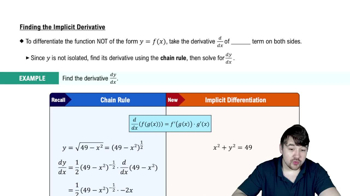
Implicit Differentiation

Implicit differentiation is used to find the derivative of y with respect to x when y is defined implicitly by an equation involving both variables. For the hyperbola equation, it allows us to differentiate both sides with respect to x to find the slope of the tangent line at a given point.
Recommended video:
05:14
Finding The Implicit Derivative

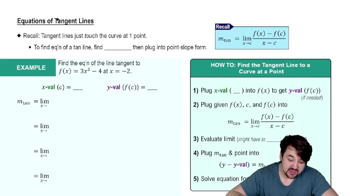
Equation of a Tangent Line

The tangent line to a curve at a point has a slope equal to the derivative of the curve at that point. Once the slope is found, the tangent line equation can be written using the point-slope form: y - y₀ = m(x - x₀), where m is the slope and (x₀, y₀) is the point of tangency.
Recommended video:
05:14
Equations of Tangent Lines

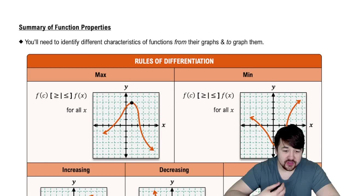
Hyperbola Equation and Properties

A hyperbola is defined by the equation x²/a² - y²/b² = 1 (or similar forms). Understanding its standard form and properties helps identify the correct implicit differentiation steps and interpret the geometric meaning of the tangent line at a specific point on the curve.
Recommended video:
06:21
Properties of Functions
Related Practice
Textbook Question

53–56. Circular motion Find parametric equations that describe the circular path of the following objects. For Exercises 53–55, assume (x, y) denotes the position of the object relative to the origin at the center of the circle. Use the units of time specified in the problem. There are many ways to describe any circle.


A bicyclist rides counterclockwise with constant speed around a circular velodrome track with a radius of 50 m, completing one lap in 24 seconds.

47
views
Textbook Question

15–30. Working with parametric equations Consider the following parametric equations.

a. Eliminate the parameter to obtain an equation in x and y.

b. Describe the curve and indicate the positive orientation.


x = r − 1, y = r³; −4 ≤ r ≤ 4

50
views
Textbook Question

33–40. Areas of regions Make a sketch of the region and its bounding curves. Find the area of the region.


The region inside the curve r = √(cos θ)

58
views
Textbook Question

11–20. Slopes of tangent lines Find the slope of the line tangent to the following polar curves at the given points.


r = 4 + sin θ; (4, 0) and (3, 3π/2)

77
views
Textbook Question

37–52. Curves to parametric equations Find parametric equations for the following curves. Include an interval for the parameter values. Answers are not unique.


The left half of the parabola y=x ² +1, originating at (0, 1)

58
views
Textbook Question

Spiral arc length Consider the spiral r=4θ, for θ≥0.


a. Use a trigonometric substitution to find the length of the spiral, for 0≤θ≤√8.

51
views