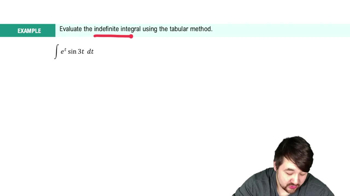
Practice with tabular integration Evaluate the following integrals using tabular integration (refer to Exercise 77). b. ∫ 7x e³ˣ dx
Verified step by step guidance
1
Identify the parts of the integrand for tabular integration: choose the algebraic function to differentiate and the exponential function to integrate. Here, let \( u = 7x \) (to differentiate) and \( dv = e^{3x} dx \) (to integrate).
Create a table with two columns: one for successive derivatives of \( u = 7x \), and one for successive integrals of \( dv = e^{3x} dx \). Differentiate \( u \) until it reaches zero, and integrate \( dv \) the same number of times.
Multiply diagonally across the table, alternating signs starting with positive. This means the first product is positive, the second is negative, and so on. Write these products as terms in the integral's expression.
Sum all the diagonal products obtained from the table to form the expression for the integral, and add the constant of integration \( + C \) at the end.
Review the result to ensure all derivatives and integrals are correctly computed, and the signs alternate properly. This completes the tabular integration process for \( \int 7x e^{3x} dx \).
Verified video answer for a similar problem:
This video solution was recommended by our tutors as helpful for the problem above
Video duration:
3m
Play a video:
0 Comments
Key Concepts
Here are the essential concepts you must grasp in order to answer the question correctly.
Integration by Parts
Integration by parts is a technique derived from the product rule of differentiation. It transforms the integral of a product of functions into simpler integrals, using the formula ∫u dv = uv - ∫v du. Choosing u and dv wisely simplifies the integration process.
Tabular integration is a streamlined approach to repeated integration by parts, especially useful when one function differentiates to zero after several steps. It organizes derivatives and integrals in a table, allowing quick computation of the integral without writing each step explicitly.
Exponential and Polynomial Functions in Integration
When integrating products of polynomial and exponential functions, the polynomial is typically chosen as u to differentiate down to zero, while the exponential is integrated repeatedly. This strategy simplifies the integral and is well-suited for tabular integration.