
Ch. 8 - Integration Techniques
Briggs - Calculus: Early Transcendentals 3rd Edition
Briggs3rd EditionCalculus: Early TranscendentalsISBN: 9780136847243Not the one you use?Change textbook
Chapter 8, Problem 8.2.75c

75. {Use of Tech} Oscillator displacements Suppose a mass on a spring that is slowed by friction has the position function:
s(t) = e⁻ᵗ sin t
c. Generalize part (b) and find the average value of the position on the interval [nπ, (n+1)π], for n = 0, 1, 2, ...

Verified step by step guidance
1
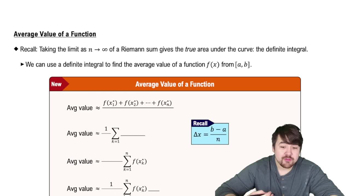
Recall that the average value of a function \(f(t)\) on an interval \([a, b]\) is given by the formula: \[\text{Average value} = \frac{1}{b - a} \int_a^b f(t) \, dt\]
Identify the function and the interval for this problem: Here, \(f(t) = s(t) = e^{-t} \sin t\), and the interval is \([n\pi, (n+1)\pi]\) where \(n = 0, 1, 2, \ldots\)
Set up the integral for the average value on the interval \([n\pi, (n+1)\pi]\): \[\text{Average value} = \frac{1}{(n+1)\pi - n\pi} \int_{n\pi}^{(n+1)\pi} e^{-t} \sin t \, dt = \frac{1}{\pi} \int_{n\pi}^{(n+1)\pi} e^{-t} \sin t \, dt\]
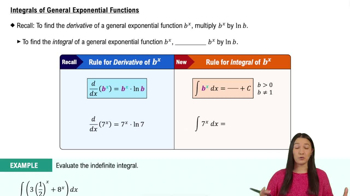
To evaluate the integral \(\int e^{-t} \sin t \, dt\), use integration by parts or recognize it as a standard integral involving exponential and trigonometric functions. The integral has a known form: \[\int e^{at} \sin(bt) \, dt = \frac{e^{at}}{a^2 + b^2} (a \sin(bt) - b \cos(bt)) + C\] In this problem, \(a = -1\) and \(b = 1\).
Apply the definite integral limits \(t = n\pi\) and \(t = (n+1)\pi\) to the antiderivative found in the previous step, then substitute back into the average value formula to express the average value in terms of \(n\). This will give a general formula for the average position on the interval \([n\pi, (n+1)\pi]\).

Verified video answer for a similar problem:

This video solution was recommended by our tutors as helpful for the problem above.
Video duration:
8m
Was this helpful?

Key Concepts

Here are the essential concepts you must grasp in order to answer the question correctly.

Average Value of a Function

The average value of a function f(t) over an interval [a, b] is given by (1/(b - a)) times the integral of f(t) from a to b. It represents the mean height of the function on that interval and is useful for understanding the overall behavior of oscillating or varying functions.
Recommended video:
06:37
Average Value of a Function

Integration of Exponential and Trigonometric Functions

Integrating functions like e^(-t) sin(t) involves techniques such as integration by parts or recognizing standard integral forms. Understanding how to handle the product of an exponential decay and a sinusoidal function is essential for solving problems involving damped oscillations.
Recommended video:
05:11
Integrals of General Exponential Functions

Properties of Oscillatory Functions on Intervals of Length π

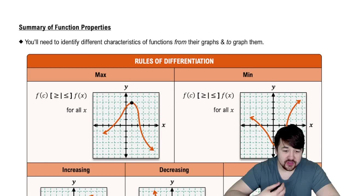
Sine functions have a period of 2π, but analyzing them over intervals of length π, such as [nπ, (n+1)π], helps in studying half-period behavior. This is important when combined with damping factors like e^(-t), as it affects the average value and sign of the oscillations over each interval.
Recommended video:
06:21
Properties of Functions
Related Practice
Textbook Question

45–48. {Use of Tech} Trapezoid Rule and Simpson’s Rule Consider the following integrals and the given values of n.

48. ∫(0 to π/4) (1/(1 + x²)) dx; n = 64

c. Compute the absolute errors in the Trapezoid Rule and Simpson’s Rule with 2n subintervals.

68
views
Textbook Question

Gaussians An important function in statistics is the Gaussian (or normal distribution, or bell-shaped curve), f(x) = e^(-ax²).

c. Complete the square to evaluate ∫ from -∞ to ∞ of e^(-(ax² + bx + c)) dx, where a > 0, b, and c are real numbers.

78
views
Textbook Question

43. A hot-air balloon is launched from an elevation of 5400 ft above sea level. As it rises, the vertical velocity is computed using a device (called a variometer) that measures the change in atmospheric pressure. The vertical velocities at selected times are shown in the table (with units of ft/min).

c. A polynomial that fits the data reasonably well is:

g(t) = 3.49t³ - 43.21t² + 142.43t - 1.75

Estimate the elevation of the balloon after five minutes using this polynomial.

74
views
Textbook Question

45–48. {Use of Tech} Trapezoid Rule and Simpson’s Rule Consider the following integrals and the given values of n.

45. ∫(0 to 1) e^(2x) dx; n = 25

c. Compute the absolute errors in the Trapezoid Rule and Simpson’s Rule with 2n subintervals.

67
views
Textbook Question

Computing areas On the interval [0,2], the graphs of f(x)=x²/3 and g(x)=x²(9−x²)^(-1/2) have similar shapes.

c. Which region has greater area?

64
views
Textbook Question

60. Two Methods

c. Verify that your answers to parts (a) and (b) are consistent.

37
views