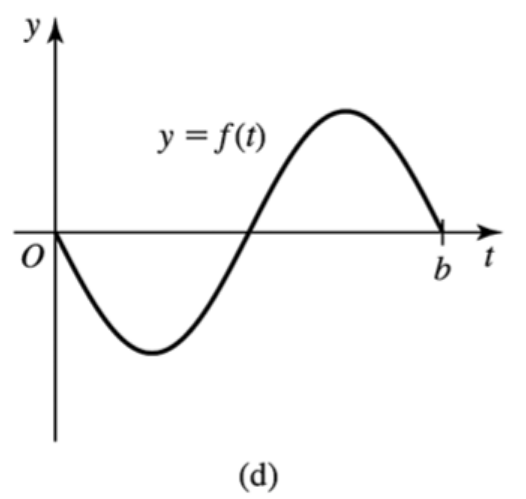
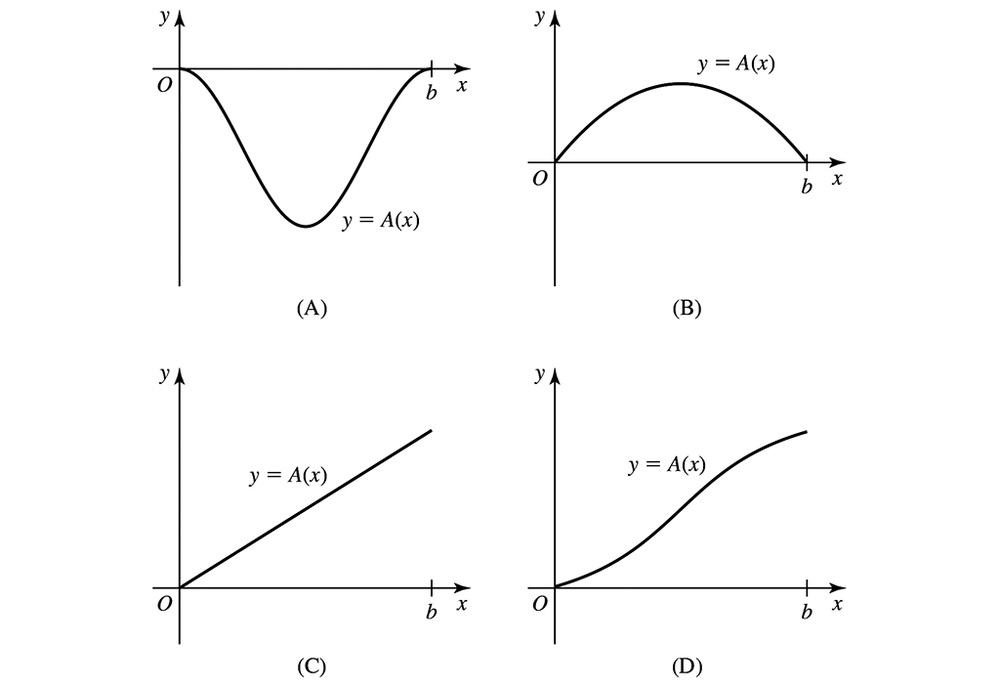
Matching functions with area functions Match the functions ƒ, whose graphs are given in a― d, with the area functions A (𝓍) = ∫₀ˣ ƒ(t) dt, whose graphs are given in A–D.
Verified step by step guidance
1
Recall that the area function \(A(x) = \int_0^x f(t) \, dt\) represents the accumulated area under the curve of \(f(t)\) from 0 to \(x\). The derivative of \(A(x)\) is \(f(x)\), i.e., \(A'(x) = f(x)\).
Analyze the graph of \(f(t)\) (graph d): Identify where \(f(t)\) is positive, negative, increasing, or decreasing. Notice that \(f(t)\) starts at 0, goes negative, then positive, and returns to 0 at \(t = b\).
Look at each candidate graph for \(A(x)\) (graphs A, B, C, D) and consider the slope at each point, since the slope of \(A(x)\) at \(x\) must equal \(f(x)\) at that point.
Match the behavior of \(f(t)\) with the slope of each \(A(x)\) graph: For example, where \(f(t)\) is negative, \(A(x)\) should be decreasing; where \(f(t)\) is positive, \(A(x)\) should be increasing; and where \(f(t)\) crosses zero, \(A(x)\) should have a horizontal tangent (slope zero).
Use these observations to pair the graph of \(f(t)\) with the correct graph of \(A(x)\) by checking which \(A(x)\) graph's slope pattern matches the \(f(t)\) graph's values.
Verified video answer for a similar problem:
This video solution was recommended by our tutors as helpful for the problem above
Video duration:
3m
Play a video:
0 Comments
Key Concepts
Here are the essential concepts you must grasp in order to answer the question correctly.
Definite Integral as Area Function
The definite integral of a function f(t) from 0 to x, denoted A(x) = ∫₀ˣ f(t) dt, represents the net area between the graph of f and the t-axis over [0, x]. Positive areas above the axis add to A(x), while areas below subtract, affecting the shape of the area function.
The area function A(x) is an antiderivative of f(x), meaning A'(x) = f(x). This implies that the slope of the graph of A at any point x equals the value of f at x. Thus, where f is positive, A is increasing; where f is negative, A is decreasing.
Interpreting Graphs to Match Functions and Area Functions
Matching graphs of f and A requires analyzing where f is positive or negative and how the area accumulates. For example, if f dips below zero, A will decrease in that interval. Points where f crosses zero correspond to local maxima or minima in A, reflecting changes in slope direction.