Ch. 2 - Limits
Briggs - Calculus: Early Transcendentals 3rd Edition
Briggs3rd EditionCalculus: Early TranscendentalsISBN: 9780136847243Not the one you use?Change textbook
Chapter 2, Problem 52

Determine the following limits.


Assume the function g satisfies the inequality 1≤g(x) ≤sin^2 x + 1, for all values of x near 0. Find lim x→0 g(x).

Verified step by step guidance
1
Step 1: Understand the inequality constraint on g(x), which is 1 \(\leq\) g(x) \(\leq\) \(\sin\)^2(x) + 1 for all x near 0.
Step 2: Evaluate the behavior of \(\sin\)^2(x) as x approaches 0. Recall that \(\sin\)(x) \(\approx\) x when x is near 0, so \(\sin\)^2(x) \(\approx\) x^2.
Step 3: Determine the limit of \(\sin\)^2(x) + 1 as x approaches 0. Since \(\sin\)^2(x) \(\to\) 0 as x \(\to\) 0, it follows that \(\sin\)^2(x) + 1 \(\to\) 1.
Step 4: Apply the Squeeze Theorem. Since 1 \(\leq\) g(x) \(\leq\) \(\sin\)^2(x) + 1 and both bounds approach 1 as x approaches 0, the Squeeze Theorem implies that \(\lim\)_{x \(\to\) 0} g(x) = 1.
Step 5: Conclude that the limit of g(x) as x approaches 0 is 1, based on the application of the Squeeze Theorem.

Verified video answer for a similar problem:

This video solution was recommended by our tutors as helpful for the problem above.
Video duration:
4m
Was this helpful?

Key Concepts

Here are the essential concepts you must grasp in order to answer the question correctly.

Limit of a Function

The limit of a function describes the value that the function approaches as the input approaches a certain point. In this case, we are interested in the behavior of g(x) as x approaches 0. Understanding limits is fundamental in calculus, as it lays the groundwork for concepts such as continuity and derivatives.
Recommended video:
06:11
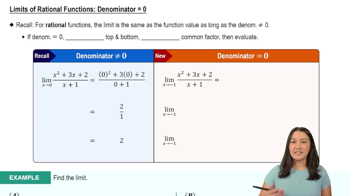
Limits of Rational Functions: Denominator = 0

Squeeze Theorem

The Squeeze Theorem is a principle used to find limits of functions that are bounded by two other functions whose limits are known. If a function g(x) is squeezed between two functions that both approach the same limit as x approaches a certain value, then g(x) must also approach that limit. This theorem is particularly useful when direct evaluation of the limit is difficult.
Recommended video:
05:12
Finding Global Extrema (Extreme Value Theorem)

Behavior of Sinusoidal Functions

Sinusoidal functions, such as sine and cosine, exhibit periodic behavior and have specific limits as their arguments approach certain values. For example, sin^2(x) approaches 0 as x approaches 0. Understanding the behavior of these functions near critical points is essential for evaluating limits involving trigonometric expressions.
Recommended video:
5:46
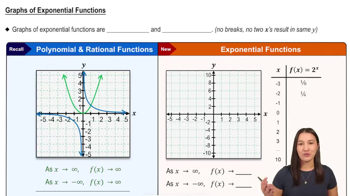
Graphs of Exponential Functions