Derivatives from a table Use the following table to find the given derivatives. <IMAGE> d/dx (f(x)g(x)) |x=1
Verified step by step guidance
1
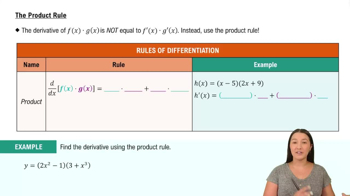
Step 1: Recall the product rule for derivatives, which states that if you have two functions f(x) and g(x), the derivative of their product is given by (f(x)g(x))' = f'(x)g(x) + f(x)g'(x).
Step 2: Identify the values you need from the table. You will need f(1), f'(1), g(1), and g'(1) to apply the product rule at x = 1.
Step 3: Substitute the values from the table into the product rule formula. This means replacing f(x) with f(1), f'(x) with f'(1), g(x) with g(1), and g'(x) with g'(1).
Step 4: Calculate each term separately. First, compute f'(1)g(1) and then compute f(1)g'(1).
Step 5: Add the results from Step 4 to find the derivative of the product at x = 1.
Verified video answer for a similar problem:
This video solution was recommended by our tutors as helpful for the problem above
Video duration:
2m
Play a video:
Was this helpful?
Key Concepts
Here are the essential concepts you must grasp in order to answer the question correctly.
Product Rule
The Product Rule is a fundamental principle in calculus used to differentiate the product of two functions. It states that if you have two functions, f(x) and g(x), the derivative of their product is given by d/dx(f(x)g(x)) = f'(x)g(x) + f(x)g'(x). This rule is essential for solving problems involving the differentiation of products, especially when values are provided in a table.
Evaluating derivatives at a specific point involves substituting the value of x into the derivative expression after applying the appropriate differentiation rules. In this case, after using the Product Rule, you will substitute x = 1 into the resulting expression to find the derivative at that point. This step is crucial for obtaining a numerical answer from the derivative function.
When derivatives are calculated using a table, it is important to extract the necessary function values and their derivatives from the provided data. The table typically lists values of f(x), g(x), and their respective derivatives at specific points. Understanding how to read and interpret this table is vital for applying the Product Rule correctly and finding the required derivative at the specified point.